Google Ads vs Facebook Ads: Which Platform Generates Better Leads & ROI in 2026?
- By admin
- Aug 24, 2026







Choosing between Google Ads and Facebook Ads is one of the most common challenges businesses face when planning a paid advertising strategy.
Both platforms can generate leads, sales, website traffic, and brand awareness. However, they work differently and are designed around different stages of the customer journey.
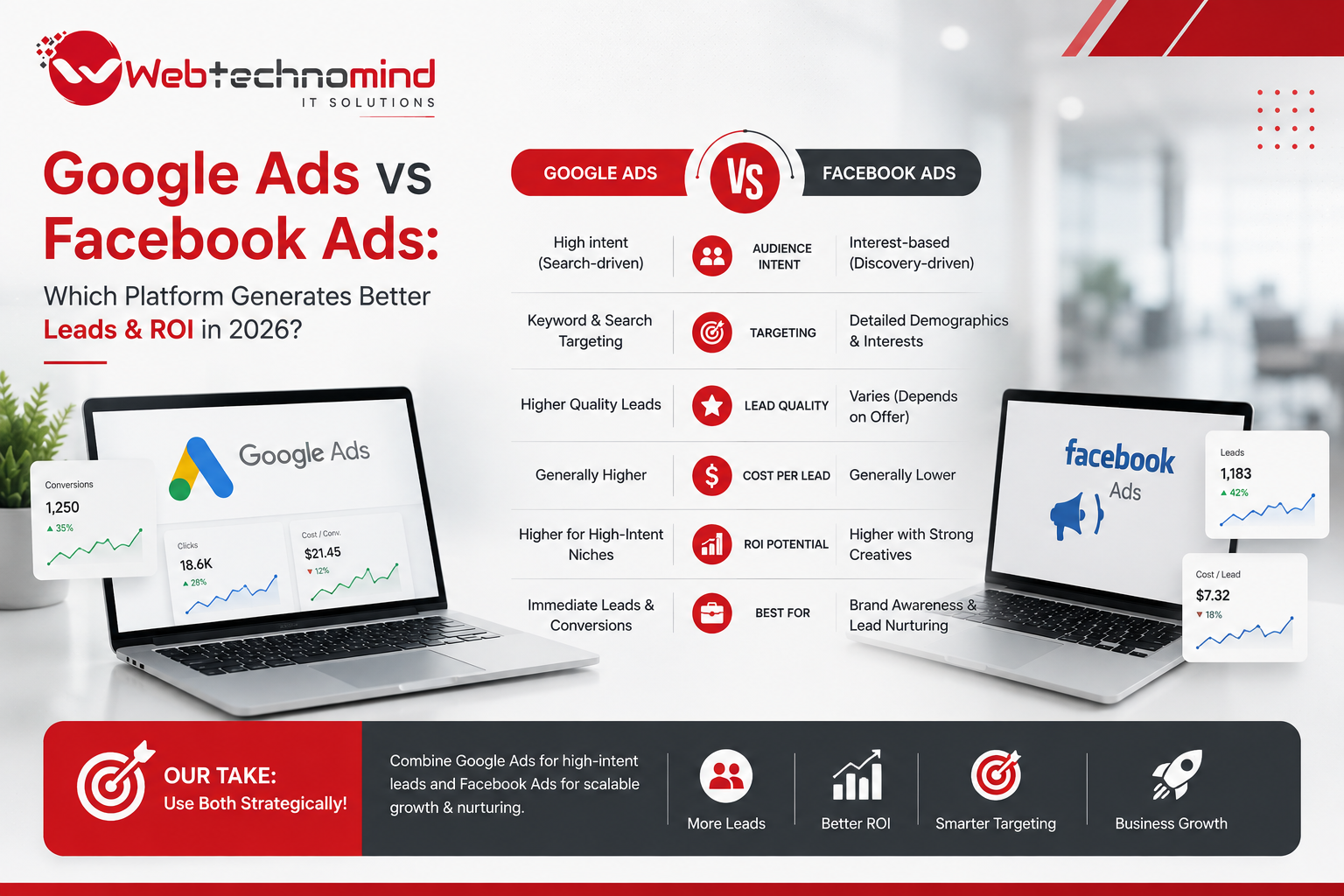
Google Ads primarily captures existing demand. Facebook Ads, now part of Meta’s advertising ecosystem, is particularly strong at creating and influencing demand through audience-based advertising. Current 2026 comparisons continue to highlight this fundamental difference.
So, which platform generates better leads and ROI in 2026?
The answer depends on your industry, target audience, offer, sales cycle, advertising budget, and campaign objective.
The simplest way to understand the difference is:
Google Ads = Capture Intent
Facebook Ads = Create Demand
When someone searches Google for:
“best digital marketing agency near me”
they already have a problem and are actively looking for a solution.
When someone sees a Facebook or Instagram advertisement for digital marketing services while browsing social media, they may not have been actively searching for an agency.
This makes Google particularly powerful for high-intent lead generation, while Facebook can be highly effective for audience building, awareness, discovery, and demand generation.
Google Search Ads place advertisements in front of users based on their search queries.
For example:
“Google Ads management company”
“SEO agency for small business“
“web development company India”
These searches can indicate commercial intent.
Google Ads can therefore be especially effective for:
The major advantage is that businesses are reaching people who are already expressing a need.
Facebook Ads uses audience-based advertising across Meta’s ecosystem, including Facebook and Instagram.
Advertisers can build campaigns around factors such as:
Instead of waiting for someone to search for your service, Facebook can introduce your product or service to people who may be interested.
This makes it particularly useful for:
For many high-intent service businesses, Google Ads can produce stronger lead quality because users are actively searching for solutions.
However, this does not mean every Google lead is valuable.
A poorly structured campaign can generate irrelevant clicks and low-quality enquiries.
Similarly, Facebook can generate large numbers of inexpensive leads, but lead quality may vary depending on targeting, creative, offer, and qualification process.
The real metric should be:
Qualified Leads ÷ Total Leads
rather than simply counting the number of leads.
Advertising costs vary significantly by:
Google Search traffic can have a higher cost per click because advertisers compete for users who are actively searching for commercial solutions.
Facebook can often provide cheaper reach and clicks, making it attractive for generating awareness and testing different offers.
However, lower CPC does not automatically mean higher ROI.
A ₹20 click that never produces a customer is more expensive than a ₹100 click that generates a profitable sale.
ROI should be calculated based on actual business revenue rather than clicks or impressions.
For example:
Ad Spend: ₹100,000
Leads: 50
Qualified Leads: 30
Customers: 8
Revenue: ₹500,000
Ad Spend: ₹100,000
Leads: 150
Qualified Leads: 35
Customers: 6
Revenue: ₹350,000
Facebook generated three times as many leads, but Google generated more customers and revenue.
This is why lead volume alone should never determine which platform is better.
For B2B businesses, Google Ads can often be the stronger starting point when there is established search demand.
Examples include:
People actively searching for these solutions may already have a business problem that needs to be solved.
Facebook can still be useful for B2B, particularly for:
A combined strategy can therefore work better than relying exclusively on one platform.
E-commerce businesses often benefit from using both platforms.
Google can capture users who are already searching for products.
Facebook can create demand through visual advertising, product discovery, promotions, and retargeting.
For example:
Google: User searches for “buy running shoes online.”
Facebook: User discovers a new running shoe brand through a video or product advertisement.
This creates two different customer acquisition opportunities.
For many D2C brands, Meta can be particularly useful for creative testing and demand generation, while Google can capture existing purchase intent.
For local businesses, Google Ads can be highly effective when customers actively search for services.
Examples:
Search intent can make these users valuable prospects.
Facebook Ads can complement this by promoting:
Facebook Ads generally has an advantage for visual brand discovery and audience reach.
Businesses can use videos, images, carousels, testimonials, product demonstrations, and other creative formats to introduce their brands to potential customers.
Google Display campaigns can also support awareness, but Search and Display should not be treated as identical advertising channels.
Accurate conversion tracking is essential on both platforms.
For Google Ads, businesses should track:
For Facebook Ads, businesses should similarly track:
Where possible, connect advertising data with your CRM so you can determine which campaigns produce actual customers rather than just leads.
For many businesses, the question should not be:
“Google Ads or Facebook Ads?”
Instead, ask:
“How should we use Google Ads and Facebook Ads together?”
A powerful funnel could look like:
Facebook Ads → Awareness → Website Visit → Retargeting → Google Search → Conversion
Or:
Google Search → Website Visit → No Conversion → Facebook Retargeting → Conversion
Each platform can support a different stage of the customer journey.
Consider these factors:
Do not compare platforms using CPC alone.
Monitor:
The most important metric is the one closest to actual business revenue.
Businesses often make these mistakes when comparing Google and Facebook Ads:
A cheap lead is not necessarily a good lead.
A Facebook awareness campaign should not be directly compared with a Google lead-generation campaign.
Track what happens after the lead enters your CRM.
Search Ads and social ads require different messaging approaches.
Use dedicated landing pages aligned with the advertisement.
Without reliable tracking, ROI calculations can be misleading.
There is no universal winner.
Google Ads is generally stronger for capturing high-intent demand.
Facebook Ads is generally stronger for creating demand, audience discovery, visual advertising, and remarketing.
If your customers are actively searching for your products or services, Google Ads may be the better starting point.
If your product requires discovery, visual storytelling, or audience education, Facebook Ads may offer greater opportunities.
For many businesses, however, the strongest strategy is to use both platforms together.
The key is to stop measuring advertising success based only on clicks, impressions, or lead volume. Measure qualified leads, customers, revenue, and acquisition cost.
When campaigns are properly targeted, conversion tracking is accurate, landing pages are optimized, and budgets are allocated according to actual performance, both Google Ads and Facebook Ads can generate strong returns.
Read More
If you’re spending money on digital ads, you’ve probably asked yourself: Google Ads vs Facebook Ads — which...

Google ads vs. Facebook ads are the most controversial battle in the world of digital marketing. Think of...