Instagram Ads Guide 2026: How to Create High-Converting Campaigns That Drive Sales
- By admin
- Aug 24, 2026

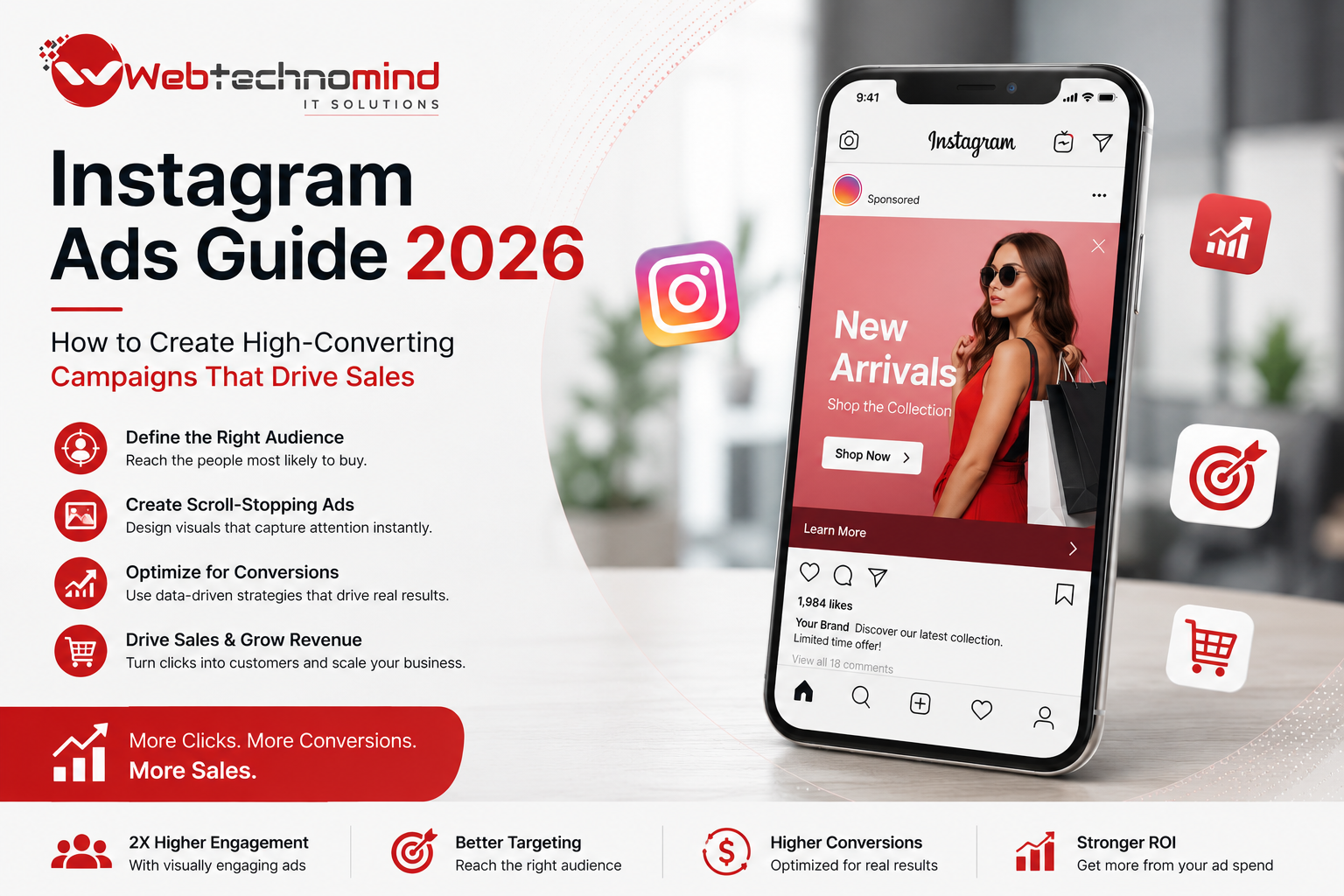







Instagram advertising has become one of the most effective ways for businesses to reach potential customers, build brand awareness, generate leads, and drive online sales. In 2026, however, simply boosting a post and waiting for results is no longer enough.
Successful Instagram advertising requires a combination of the right campaign objective, audience strategy, creative content, landing page experience, tracking, and continuous optimization. Meta is also increasingly using automation and AI-driven delivery to help advertisers find people who are more likely to take meaningful actions.
Whether you run an eCommerce store, service business, startup, personal brand, or established company, this Instagram Ads guide will help you understand how to create campaigns designed for real business results.
Instagram Ads are paid advertisements that businesses run through Meta’s advertising platform to promote products, services, content, apps, or offers to targeted audiences.
Ads can appear across Instagram placements such as:
Instagram advertising can support different business goals, including awareness, traffic, engagement, lead generation, app promotion, and sales.
For businesses focused on revenue, the key is to optimize campaigns for actions that directly contribute to business growth rather than focusing only on likes, impressions, or followers.
Instagram continues to be a highly visual platform where consumers discover products, research brands, watch short-form videos, and make purchasing decisions.
The biggest opportunity in 2026 is the combination of strong creative content and Meta’s increasingly automated advertising capabilities. Instead of manually controlling every aspect of audience targeting, advertisers can give Meta strong signals and quality creative assets while allowing its delivery systems to identify promising users.
Meta recommends testing Reels placements and using creative specifically designed for vertical video experiences. Its guidance also highlights the importance of strong visuals, quick hooks, subtitles, and clear messaging.
This means advertisers should think less about creating traditional advertisements and more about creating content that naturally fits the Instagram experience.
Before creating an Instagram campaign, determine exactly what you want the campaign to accomplish.
For example:
If your primary goal is revenue, your campaign structure should be built around conversions and sales rather than vanity metrics.
A campaign generating thousands of clicks but very few purchases is not necessarily successful. Always connect your advertising objective to a measurable business outcome.
One of the biggest mistakes advertisers make is trying to target everyone.
Instead, define your ideal customer based on factors such as:
For example, a premium skincare brand may target users interested in skincare and beauty while also creating retargeting audiences for people who have already visited product pages.
Your strategy should include both new customer acquisition and retargeting.
Cold audiences help you discover new customers, while warm audiences can include people who watched your videos, interacted with your Instagram profile, visited your website, or previously engaged with your products.
Instagram gives advertisers multiple creative formats, but short-form video deserves particular attention in 2026.
Reels are ideal for demonstrating products, explaining services, showing transformations, answering customer questions, and telling short stories.
Your first few seconds matter. Meta recommends using motion or compelling visuals immediately to capture attention. Subtitles and strong visual communication can also make video ads easier to understand.
Stories are useful for limited-time promotions, product launches, discounts, testimonials, and direct-response campaigns.
Because Stories are immersive and vertical, your creative should be designed specifically for the format rather than simply resizing a desktop advertisement.
Feed ads remain useful for product promotions, educational content, testimonials, and brand storytelling.
Carousel ads can be especially effective when you need to showcase multiple products, features, benefits, or steps.
Great targeting cannot rescue weak creative.
Your advertisement needs to answer three questions quickly:
What is this?
Why should I care?
What should I do next?
Start with a strong hook.
Examples include:
Then introduce the problem, present your solution, provide proof, and finish with a clear call to action.
Avoid making every advertisement look like a traditional corporate commercial. Authentic demonstrations, customer experiences, educational videos, product usage clips, and creator-style content can often feel more natural within Instagram’s environment.
Your CTA should clearly tell users what to do next.
Examples include:
Don’t confuse users with multiple competing actions. If the campaign is designed to generate purchases, make the purchasing path obvious.
Your ad and landing page should also communicate the same offer. If your advertisement promotes a discount but the landing page does not clearly show that discount, conversion rates can suffer.
Instagram Ads do not operate independently from your website.
Even an excellent advertisement can fail if the landing page is slow, confusing, difficult to navigate, or poorly optimized for mobile devices.
Your landing page should have:
The journey should feel seamless from Instagram to your website.
Tracking is essential if you want to understand whether Instagram advertising is actually generating revenue.
Make sure your website and advertising setup can measure important actions such as:
Without reliable tracking, it becomes difficult to identify which campaigns, audiences, and creatives are actually producing business results.
Don’t judge campaigns only by impressions or clicks. Look deeper into conversion rate, cost per acquisition, return on ad spend, and actual revenue.
One of the most effective ways to improve Instagram Ads performance is continuous creative testing.
Instead of creating one advertisement and running it for months, develop multiple variations.
Test:
For example, one ad could focus on price, another on quality, and another on solving a specific customer problem.
Meta recommends testing and learning with A/B testing, while its Reels guidance encourages advertisers to use creative suited to the placement.
The goal is not to guess which advertisement will win. The goal is to collect performance data and continuously improve.
Many people will not purchase the first time they see your advertisement.
That’s normal.
Someone may visit your website, browse a product, watch a video, or add something to their cart before leaving.
Retargeting allows you to reconnect with these users.
You can create different messages for different stages of the customer journey. For example:
Website visitor: Highlight product benefits.
Product viewer: Show reviews or demonstrations.
Cart abandoner: Reinforce value and address purchase concerns.
Existing customer: Promote complementary products or repeat purchases.
This makes your advertising more relevant and can improve the efficiency of your marketing budget.
Some of the most important metrics to monitor include:
CTR: Measures how often people click after seeing the advertisement.
CPC: Shows how much you’re paying for clicks.
Conversion Rate: Measures how many visitors complete the desired action.
CPA: Shows the cost of acquiring a customer or lead.
ROAS: Measures revenue generated compared with advertising spend.
Frequency: Helps identify when audiences may be seeing the same advertisement too often.
However, don’t optimize every campaign based on one metric. A low CPC does not automatically mean a profitable campaign. The ultimate objective should be meaningful business results.
Avoid these common mistakes in 2026:
Meta’s advertising guidance specifically recommends vertical or square creative and emphasizes keeping important visual elements within safe areas for placements such as Reels.
The most effective Instagram Ads strategy is not simply about spending more money. It is about building a complete conversion system.
Start with a clear objective. Understand your customer. Create native, attention-grabbing creative. Test multiple messages. Use appropriate placements. Track conversions. Retarget interested users. Then scale the combinations that consistently produce profitable results.
AI and automation can help advertisers with delivery and optimization, but human strategy remains critical. Your offer, positioning, creative concept, customer understanding, and landing page experience still determine whether people care enough to take action.
Instagram Ads in 2026 offer businesses a powerful opportunity to turn attention into measurable growth. But successful campaigns require more than attractive images and a large advertising budget.
The winning formula is simple:
Right audience + compelling creative + strong offer + optimized landing page + accurate tracking + continuous testing = better Instagram Ads performance.
Whether you’re promoting an eCommerce product, professional service, app, course, or local business, focus on creating advertisements that solve real customer problems and make the next step obvious.
Instagram users are constantly scrolling, so your job is to earn their attention quickly, build trust, and give them a compelling reason to act. When every part of the customer journey is optimized around that goal, Instagram advertising can become a reliable channel for generating leads, sales, and long-term business growth.
Read More
Generating leads through Meta Ads can be one of the most effective ways for businesses to reach potential...

Most website visitors do not convert on their first visit. They may browse your products, compare prices, read...
Running Facebook and Instagram ads without accurate conversion tracking is like driving with no dashboard. You may see...

Meta Conversions API Setup Guide: Improve Tracking Accuracy After iOS Privacy Updates Meta advertising has changed significantly as...