Meta Lead Generation Ads Guide: How to Generate High-Quality Leads at Lower Cost
- By admin
- Aug 26, 2026

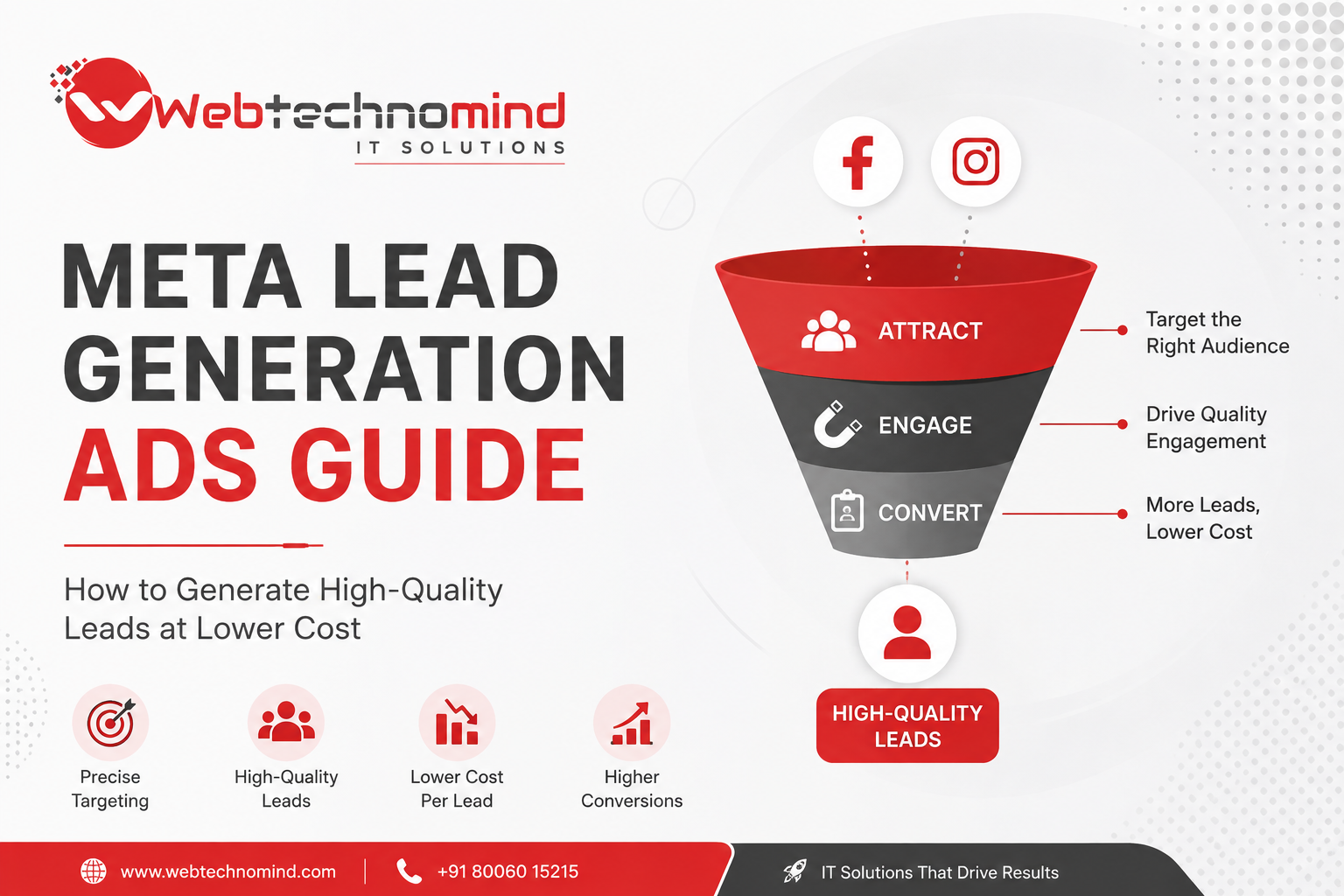







Generating leads through Meta Ads can be one of the most effective ways for businesses to reach potential customers on Facebook and Instagram. However, getting a large number of leads does not always mean getting high-quality leads. Many businesses struggle with expensive campaigns, irrelevant inquiries, low conversion rates, and leads that never respond.
The real goal of Meta lead generation advertising is not simply to reduce cost per lead (CPL). It is to generate qualified prospects at a sustainable cost who have a genuine interest in your product or service.
In this guide, we will explore how Meta Lead Generation Ads work, how to set up campaigns, and practical strategies to generate better leads while keeping acquisition costs under control.
Meta Lead Generation Ads are advertising campaigns on Facebook and Instagram that allow businesses to collect customer information directly within the Meta platform.
Instead of sending users to an external landing page, businesses can use an Instant Form to collect details such as:
Because users do not need to leave Facebook or Instagram, the process can be faster and easier, particularly on mobile devices.
However, the success of a campaign depends heavily on targeting, creative quality, offer, form design, and lead qualification.
Meta has access to a large amount of behavioral and interest-based data, allowing advertisers to reach specific audiences based on demographics, interests, engagement, and other signals.
Lead Ads can also reduce friction in the conversion process. A potential customer can see an advertisement, click the call-to-action, complete a form, and submit their information without visiting another website.
This makes Meta particularly useful for businesses offering:
The important point is that more leads are not necessarily better leads. Campaign optimization should focus on lead quality and business outcomes.
One of the biggest mistakes advertisers make is launching campaigns before defining their ideal customer.
Start by answering:
Who is most likely to buy from us?
Consider factors such as:
For B2B campaigns, for example, targeting decision-makers and business owners may be more valuable than targeting a broad audience.
A clearly defined ideal customer profile helps Meta’s delivery system find people who are more likely to become genuine prospects.
People rarely submit their contact information without a reason.
Instead of creating a generic advertisement such as “Contact Us Today,” give users something valuable.
Depending on your business, this could be:
Your offer should solve a specific problem or provide a clear benefit.
For example, a digital marketing agency could promote:
“Get a Free 15-Minute SEO Growth Consultation.”
This is more specific than simply saying “Contact Our SEO Experts.”
Your creative is often the first thing users notice.
A strong Meta lead generation ad should communicate three things quickly:
Problem → Solution → Action
For example:
“Not Getting Enough Qualified Leads?”
“Discover a performance-driven digital marketing strategy designed to increase qualified inquiries.”
“Book Your Free Consultation.”
Use clear visuals, short copy, strong headlines, and a prominent call-to-action.
Test different creative formats, including:
Do not assume one creative will work for every audience. Regular testing is essential.
One reason Meta campaigns generate poor-quality leads is that the form is too easy to complete.
A form asking only for a name and phone number may generate a low CPL, but it can also attract people with little buying intent.
Consider adding qualifying questions such as:
Do not make the form unnecessarily long. The objective is to find the right balance between conversion rate and lead quality.
Cost per lead is an important metric, but it should not be the only metric you monitor.
Suppose Campaign A generates 100 leads at $5 per lead, but only five become qualified prospects.
Campaign B generates 50 leads at $8 per lead, but 15 become qualified prospects.
Campaign B may actually deliver better business results despite having a higher CPL.
Track metrics such as:
This gives you a much clearer understanding of campaign profitability.
Not everyone will convert the first time they see your advertisement.
Retarget people who have already interacted with your business, such as:
Retargeting campaigns can reinforce your message and encourage users who were previously interested but did not convert.
You can also use different messaging for warm audiences. Instead of introducing your business again, focus on testimonials, case studies, offers, or specific objections.
Audience testing is another important part of lowering Meta advertising costs.
Depending on your business, test:
Avoid making too many changes simultaneously. Run structured tests so you can understand which variable is responsible for performance changes.
Generating a lead is only the beginning.
If your sales team takes several hours or days to contact a prospect, the lead may lose interest.
Ideally, new leads should enter your CRM or sales system quickly, with automated notifications sent to the relevant salesperson.
Your follow-up process can include:
A strong follow-up process can significantly improve the value generated from the same advertising budget.
One of the most powerful strategies for advanced advertisers is connecting Meta campaigns with CRM data.
Instead of optimizing only for form submissions, businesses can track what happens after a lead enters the sales pipeline.
For example:
Ad → Lead → Qualified Lead → Sales Opportunity → Customer
This helps businesses understand which campaigns are generating actual customers rather than simply generating inexpensive forms.
Over time, better conversion data can help improve campaign optimization and budget allocation.
Successful Meta advertising is rarely a “set it and forget it” activity.
Test different combinations of:
Analyze performance regularly and move more budget toward campaigns that consistently generate qualified opportunities.
Avoid making decisions based on a small amount of data. Give campaigns enough time and conversions to identify meaningful performance trends.
Businesses often make several mistakes when running Meta lead campaigns.
These include:
Fixing these issues can often improve campaign performance without simply increasing the advertising budget.
Meta Lead Generation Ads can deliver powerful results when campaigns are built around lead quality rather than lead quantity.
The most effective approach combines precise audience research, compelling offers, strong creatives, smart lead forms, retargeting, fast follow-up, CRM integration, and continuous optimization.
Remember: the cheapest lead is not always the most valuable lead.
A successful Meta advertising strategy should ultimately answer one question:
How much revenue can we generate from every dollar spent on advertising?
By focusing on qualified leads, conversion rates, customer acquisition costs, and overall return on investment, businesses can build Meta campaigns that are not only cheaper—but significantly more profitable and sustainable.
Read More
Most website visitors do not convert on their first visit. They may browse your products, compare prices, read...
Running Facebook and Instagram ads without accurate conversion tracking is like driving with no dashboard. You may see...
Meta Conversions API Setup Guide: Improve Tracking Accuracy After iOS Privacy Updates Meta advertising has changed significantly as...
Instagram advertising has become one of the most effective ways for businesses to reach potential customers, build brand...