Entity SEO Explained: How Google Understands Brands, People & Topics
- By admin
- Aug 24, 2026
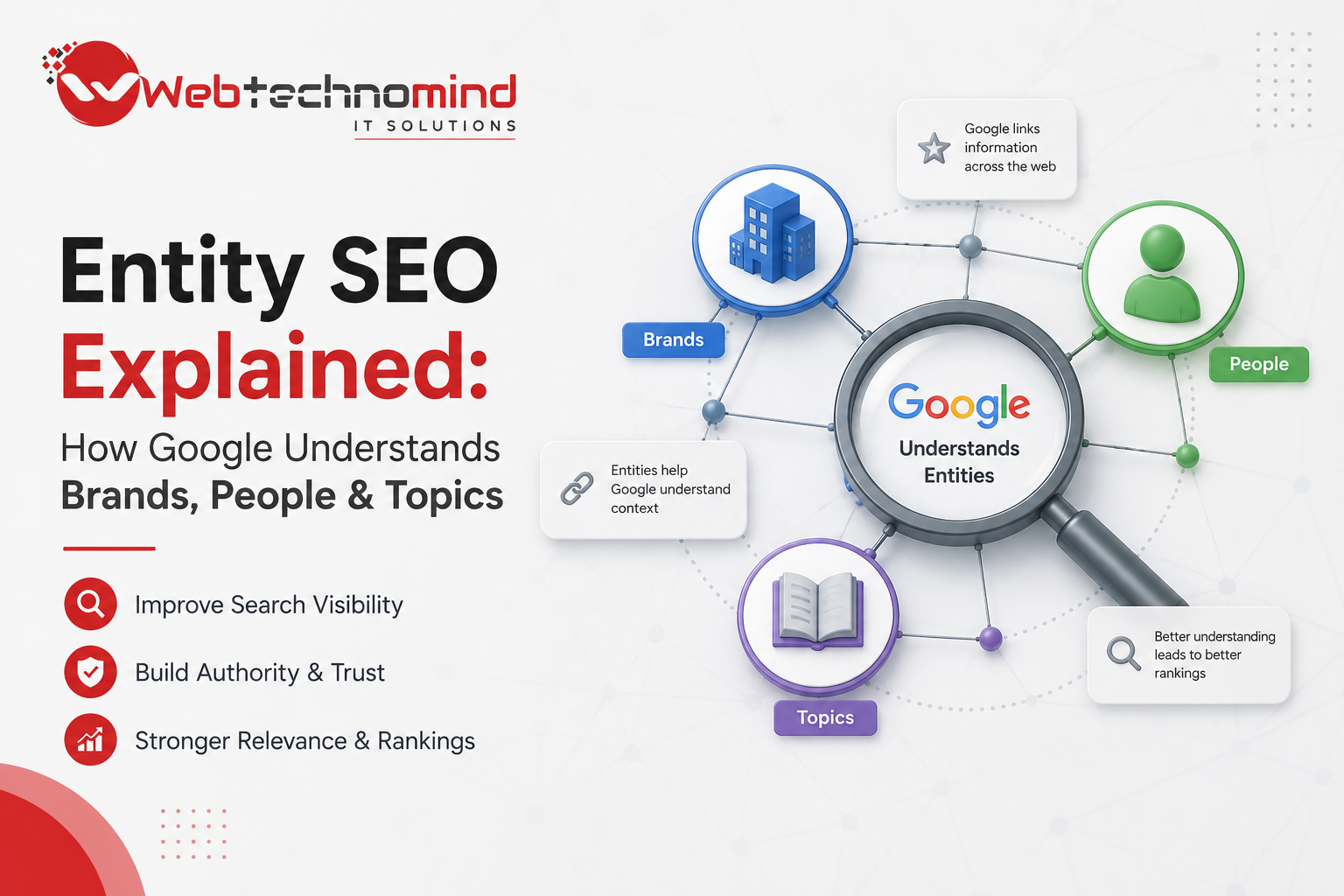







Search engines have changed significantly over the years. Earlier, Google primarily matched keywords on a webpage with the words users entered into a search box. Today, search is much more sophisticated. Google tries to understand the meaning, context, relationships, people, brands, places, products, and topics behind a search query.
This is where Entity SEO becomes important.
Entity SEO is an approach to search optimization that focuses on helping search engines clearly understand who or what a website, brand, person, product, or topic represents—and how that entity relates to other entities across the web.
For businesses investing in SEO in 2026, understanding entity-based search can help create stronger topical authority, improve brand recognition, and make content more understandable to both traditional search engines and AI-powered search experiences.
An entity is essentially a distinct, identifiable thing or concept.
For example, a company such as Apple is an entity. So are people such as Elon Musk, places such as London, products such as the iPhone, and concepts such as search engine optimization.
Google can connect these entities with attributes and relationships.
For example:
WebTechnomind → Company → Web Development → SEO → AI Integration
The goal of Entity SEO is not simply to repeat a keyword. Instead, it is to establish clear relationships between your brand and the subjects you want to be recognized for.
This helps search engines understand the broader context of your website.
Google uses numerous signals to understand entities and relationships. These signals can come from websites, structured data, authoritative publications, business profiles, public databases, links, mentions, and other sources.
One important concept is Google’s Knowledge Graph, which is designed to help Google understand real-world entities and the relationships between them.
For example, when someone searches for a well-known company, Google may understand:
This means modern SEO is increasingly about context and relationships, not just keyword placement.
Traditional SEO often focuses on optimizing a page around a specific keyword.
For example:
Keyword: “digital marketing agency”
A traditional approach might focus on placing this keyword in the title, headings, URL, content, meta description, and links.
Entity SEO goes further.
It asks:
The keyword still matters, but the semantic relationship between concepts becomes much more important.
For businesses, Entity SEO can strengthen the connection between a brand and its areas of expertise.
Imagine a company consistently publishes high-quality content about:
If those subjects are clearly connected to the company across its website and other reputable sources, search engines can build a better understanding of what the company represents.
This can support stronger topical relevance and brand visibility.
However, Entity SEO should not be treated as a shortcut for rankings. There is no single “entity SEO trick” that guarantees a top position. Search visibility depends on many factors, including content quality, relevance, technical performance, authority, user experience, and overall site quality.
Your company’s name, description, services, location, and other important information should be consistent across your website and legitimate business profiles.
Inconsistent information can make it harder for search engines and users to understand your brand.
Your About page should clearly explain:
Avoid making the page purely promotional. Focus on providing useful, verifiable information.
Structured data helps communicate information about webpages and entities in a machine-readable format.
Depending on your business, relevant Schema.org types may include:
Structured data does not guarantee higher rankings or rich results, but it can help search engines interpret page information more effectively when implemented correctly.
Publishing one article about a subject is rarely enough to establish expertise.
Instead, build a network of related content.
For example, an SEO agency could create content covering:
SEO → Technical SEO → On-Page SEO → Entity SEO → Semantic Search → Structured Data → AI Search → Content Optimization
These pages should be logically connected through internal links and written to genuinely answer different aspects of the broader topic.
This creates a clearer topical structure.
People are also important entities.
If a company’s founder, CEO, authors, or experts contribute meaningful content, their professional identity can become part of the broader context surrounding the organization.
Author pages, professional biographies, expert contributions, interviews, conference appearances, and credible third-party mentions can help establish relationships between people, organizations, and topics.
The important point is authenticity. Do not create artificial author profiles simply to manipulate search results.
Entity understanding is not limited to your own website.
When reputable websites, publications, industry platforms, and organizations mention your company, those references can provide additional context about your brand.
For example, a technology company mentioned by respected industry publications, conference websites, business directories, and professional organizations may develop a stronger digital footprint than a company that only exists on its own website.
Quality matters more than quantity.
Entity SEO is becoming particularly relevant as search experiences increasingly incorporate AI.
AI-powered search systems need to understand relationships between concepts to generate useful answers.
Consider a question such as:
“What does WebTechnoMind specialize in?”
A system needs more than a matching keyword. It needs to understand the organization, its services, its industry, and the information available about it.
This is why businesses should think beyond ranking individual pages.
The larger objective is to build a clear, consistent, trustworthy digital identity.
Businesses often make several mistakes when implementing entity-focused SEO.
Repeating a brand name or keyword excessively does not create a strong entity.
Different company names, descriptions, addresses, or other details across important platforms can create confusion.
Publishing dozens of low-quality pages around related keywords is not the same as building topical authority.
Related pages should be logically connected so users and search engines can understand how information fits together.
Adding irrelevant or inaccurate Schema markup can create problems instead of improving understanding.
Your digital identity exists beyond one search engine. Build genuine authority through your website, industry relationships, publications, profiles, and useful content.
A strong entity SEO strategy can be built around five areas:
This approach creates a more complete digital ecosystem around your brand.
Entity SEO represents a major shift in how businesses should think about search optimization.
Modern search engines are not simply asking, “Does this webpage contain the keyword?”
They are increasingly trying to understand:
“What is this page about? Who created it? What does this brand represent? How is it connected to other concepts? And can the information be trusted?”
That makes entity optimization an important part of a modern SEO strategy.
Businesses that consistently communicate their identity, demonstrate genuine expertise, create useful topic-focused content, maintain accurate information, and build credible relationships across the web can create stronger signals around their brand.
Ultimately, Entity SEO is less about manipulating search engines and more about making your brand, expertise, content, and relationships easier for search engines—and people—to understand.
Read More

Businesses today need more than basic digital tools to stay competitive. They need reliable software, streamlined workflows, secure...

Businesses today need more than a traditional website to stay competitive. From customer portals and online booking systems...
Businesses today need more than a website to succeed online. They need to be visible when potential customers...
Search is changing rapidly. People are no longer relying only on traditional Google results to discover businesses, products,...