AI Search Ranking Factors: What Helps Websites Rank in AI Search Engines
- By admin
- Aug 18, 2026

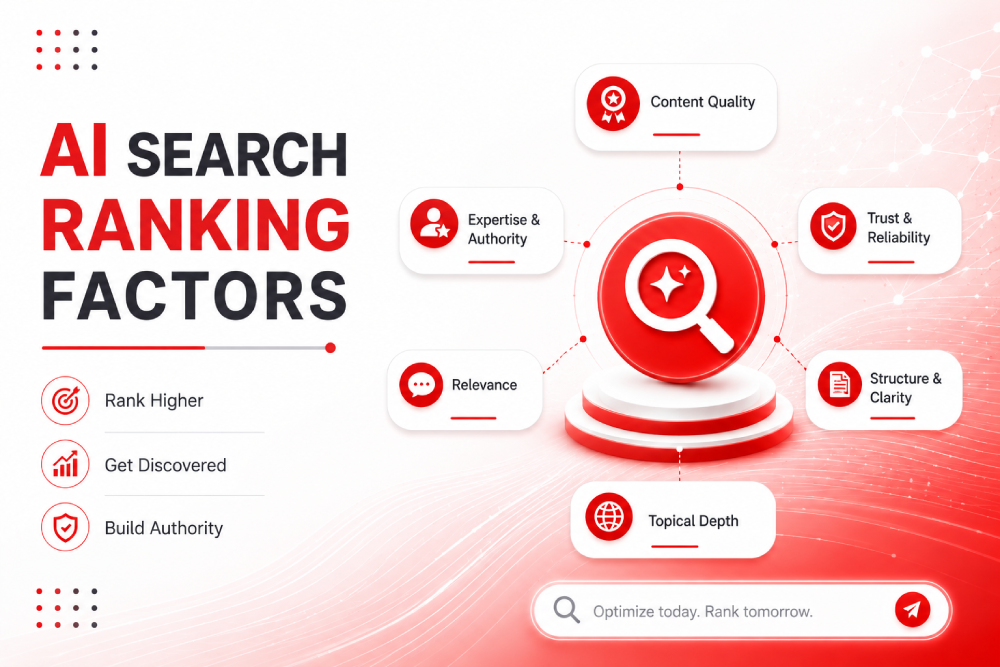







Search is evolving from traditional keyword-based results to AI-powered experiences. Platforms such as Google AI Overviews, Google AI Mode, and ChatGPT Search are changing how people discover websites, businesses, products, and information.
This shift has created a new SEO opportunity: AI search optimization.
While there is no single ranking formula for AI search engines, businesses can improve their visibility by creating useful content, establishing authority, maintaining strong technical SEO, and making their information easy for search and AI systems to understand.
In this guide, we explore the most important AI search ranking factors and how businesses can prepare their websites for the future of search.
AI search ranking factors are the signals that can influence whether a website’s content is discovered, considered, and potentially referenced in AI-powered search experiences.
Different platforms use different systems, so there is no universal checklist that guarantees visibility.
However, several common principles are important:
The goal is to create a website that provides valuable information and can be easily understood by both users and AI-powered search systems.
One of the most important AI search ranking factors is content quality.
AI-powered search systems need reliable information to generate useful answers. Publishing generic articles that simply repeat information found across the internet is unlikely to provide a strong competitive advantage.
Create content that includes:
Your content should answer the user’s question while providing additional information that genuinely helps them make a decision.
AI search users often ask detailed, conversational questions.
For example, instead of searching:
“AI development company”
a user might ask:
“What should a startup consider before hiring an AI development company?”
Your content should address the actual intent behind these questions.
Create content for different stages of the customer journey:
Understanding search intent helps your website provide answers that are relevant to what users are actually trying to accomplish.
AI search is increasingly capable of understanding relationships between topics.
This makes topical authority an important part of modern SEO.
Instead of publishing one article about a subject, build a comprehensive content ecosystem.
For example, a technology company could create a content cluster around AI development:
Connect related pages using contextual internal links.
This helps establish a clear relationship between your brand and the topics you specialize in.
Even the best content cannot perform if search systems cannot access it.
Check:
For AI-powered search, make sure important pages are accessible to relevant search crawlers.
If important pages are blocked from crawling, search engines and AI-powered search systems may have difficulty discovering your content.
Technical SEO remains important in AI-powered search.
Your website should have:
Technical optimization doesn’t guarantee AI search visibility, but it creates the foundation search systems need to discover and understand your content.
AI search systems need to provide users with useful and reliable information.
This makes brand authority increasingly important.
Build your reputation through:
Your business information should also remain consistent across your website and external platforms.
A strong digital reputation can help establish your company as a credible source within its industry.
E-E-A-T stands for:
Experience, Expertise, Authoritativeness, and Trustworthiness.
Although E-E-A-T should not be treated as a simple ranking score, these principles are useful when creating content designed for search visibility.
Demonstrate expertise through:
For example, a web development company should demonstrate real experience building websites, mobile applications, AI solutions, CRM systems, and other digital products.
AI systems need to understand the information on your website.
Make your content easy to interpret using:
Answer important questions directly.
For example, if your article targets “What is AI app development?”, provide a concise definition near the beginning before explaining technologies, benefits, costs, and development processes.
Structured data helps search engines understand information on your webpages.
Depending on your website, relevant schema types may include:
Structured data should accurately represent information visible on the page.
Structured data is not a shortcut to AI search rankings, but it can improve how search systems interpret your website.
AI can generate generic information quickly. This makes original information more valuable.
Businesses should create content based on their actual experience.
Examples include:
For example, instead of writing a generic article about website speed, publish a case study explaining how your team improved a client’s mobile performance and what results were achieved.
This creates content that is difficult for competitors to replicate.
AI search may send users to your website with more context about the topic. When visitors arrive, they should be able to quickly find the information they need.
Focus on:
A positive page experience can improve engagement and help visitors get more value from your content.
Search is becoming increasingly multimodal.
Users can search using text, images, and other forms of information. Businesses should therefore consider supporting important content with:
Visual content should provide additional value rather than simply decorate the page.
Generative AI can be useful for research, brainstorming, outlining, and editing. However, automatically producing large volumes of pages without adding meaningful value can create SEO risks.
A better content workflow is:
AI-assisted research → human expertise → original insights → fact checking → editorial review
The goal should be better content, not simply more content.
Before publishing an AI-assisted article, ask:
Does this content provide something genuinely useful that readers cannot easily find elsewhere?
If the answer is yes, it is more likely to provide meaningful value.
AI search optimization should be measured like any other digital marketing activity.
Track:
As AI search measurement continues to develop, businesses should look beyond rankings and focus on meaningful business outcomes.
To improve your website’s AI search visibility:
Traditional SEO and AI search optimization should work together.
The strongest strategy combines both approaches rather than treating AI search as a replacement for SEO.
The future of search is becoming more conversational, contextual, and AI-driven. However, there is no single AI search ranking factor that guarantees visibility.
The strongest strategy is to build a website that provides original information, demonstrates expertise, satisfies search intent, maintains strong technical foundations, and earns trust across the web.
Traditional SEO remains important, but businesses should now think beyond keyword rankings. AI search optimization requires a broader approach that combines SEO, content strategy, technical optimization, brand authority, structured data, and genuine expertise.
At WebTechnoMind, we help businesses improve their digital presence through SEO, AEO, AI solutions, web development, mobile app development, and digital marketing.
Search engines have changed significantly over the years. Earlier, Google primarily matched keywords on a webpage with the...

The way people search for information is changing rapidly. Traditional search engines are no longer the only way...

Search is evolving. People are no longer relying only on traditional search engines to find information, products, and...
Search is no longer limited to traditional search engines. People are increasingly using AI-powered tools such as ChatGPT...