AEO in SEO: The Search Landscape Is Changing
- By admin
- Aug 13, 2026

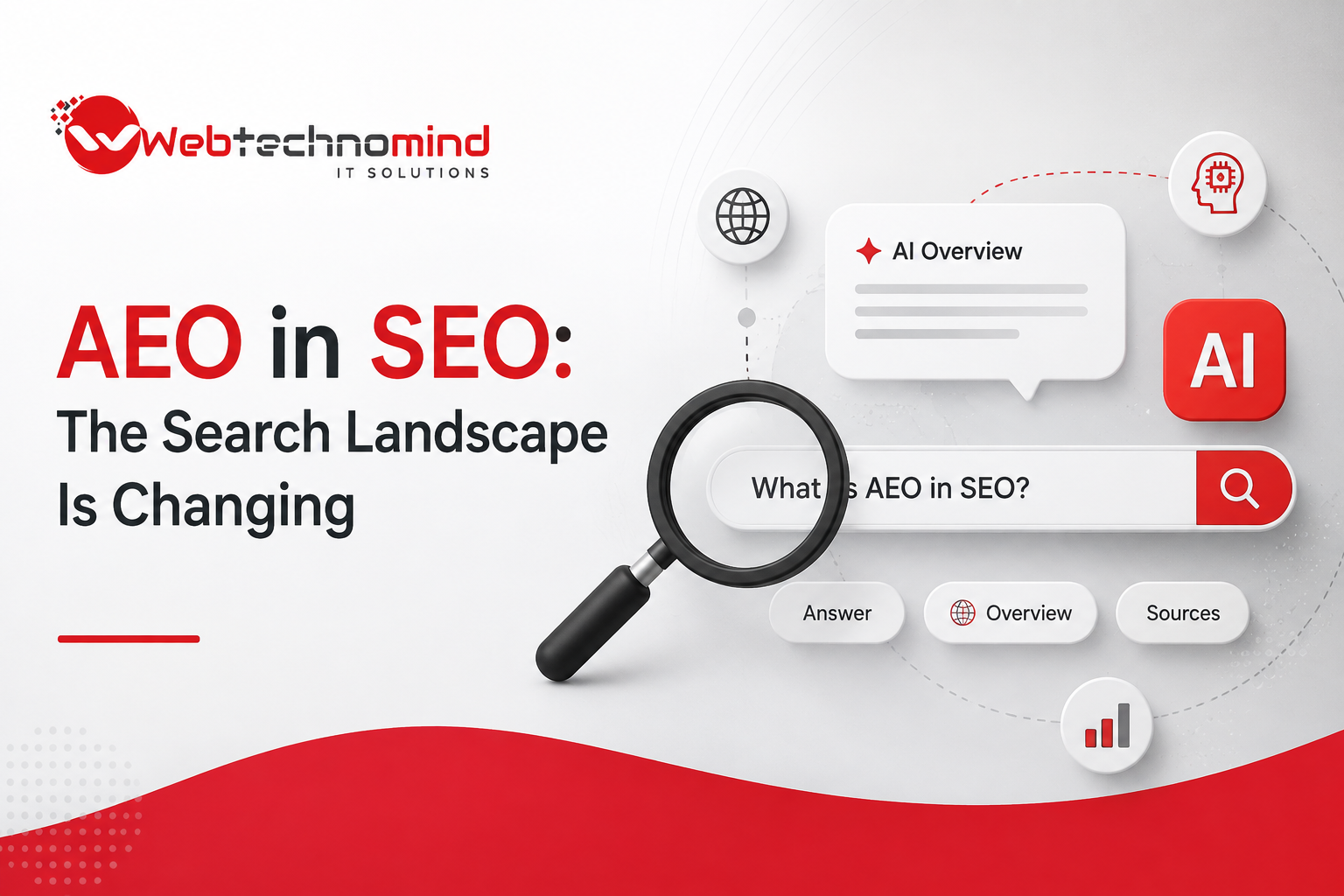







Search engine optimization is entering a new phase as users increasingly expect direct, conversational answers instead of traditional lists of website links. The rise of AI-powered search experiences has created a new optimization opportunity for businesses: Answer Engine Optimization (AEO).
AEO in SEO focuses on making online content easy for search engines, AI systems and answer engines to understand, extract and present as a direct response to a user’s question.
For years, SEO strategies focused primarily on ranking web pages on Google. Today, businesses also need to consider how their content can become the source of an answer generated by AI-powered search platforms.
This shift is changing how companies approach content creation, keyword research, technical SEO and digital visibility.
Answer Engine Optimization, or AEO, is the process of optimizing content so that it can be selected and used as a direct answer to a user’s search query.
Traditional SEO generally aims to improve a webpage’s position in search results. AEO takes this a step further by structuring information around questions and providing clear, useful and context-rich answers.
For example, instead of searching:
“best digital marketing agency Kolkata”
a user may ask an AI-powered search engine:
“Which digital marketing services should a small business use to increase online visibility?”
An answer engine may analyze information from multiple websites and provide a summarized response.
The goal of AEO is therefore not only to rank but also to make a business’s content understandable, trustworthy and answer-worthy.
The growth of conversational search is changing user behavior. People are increasingly using natural-language questions when looking for information, products, services and recommendations.
This means businesses need to move beyond simply targeting individual keywords.
Modern content strategies should consider:
AEO helps address these questions.
Businesses that adapt early can improve their visibility across traditional search results as well as emerging AI-driven search experiences.
SEO and AEO are closely connected, but their primary objectives are slightly different.
Traditional SEO focuses on improving rankings, organic traffic, backlinks, technical performance and keyword relevance.
AEO focuses more heavily on providing direct answers, satisfying search intent and structuring information so that answer engines can understand and potentially cite or summarize it.
However, AEO does not replace SEO.
Instead, AEO should be considered an extension of modern SEO.
A technically strong website with useful content, authoritative information and strong search visibility provides a solid foundation for AEO.
Businesses can incorporate several AEO techniques into their existing SEO strategy.
Start by identifying questions customers are actually asking.
Instead of targeting only keywords such as “SEO services,” create content around questions such as:
Question-based content aligns naturally with conversational search behavior.
When answering a question, provide the answer quickly.
A strong AEO structure often places a concise answer immediately below the relevant heading, followed by additional explanation.
For example:
What is AEO?
AEO, or Answer Engine Optimization, is the process of optimizing digital content so search engines and AI-powered answer systems can understand and use it to answer user queries.
The explanation can then continue with examples, benefits and supporting information.
Well-organized content is easier for both users and search engines to understand.
Use:
A clear structure also improves the overall user experience.
AEO is not simply about adding questions to a webpage.
Businesses should build comprehensive content around their areas of expertise.
For example, an SEO agency could create a content cluster covering:
SEO → Technical SEO → Local SEO → Content SEO → E-E-A-T → AEO → AI Search → Search Intent
Publishing interconnected, high-quality content can help establish topical relevance and demonstrate expertise.
Answer engines need reliable information to produce useful responses.
Businesses should therefore clearly demonstrate expertise through:
Trust remains an important part of successful search visibility.
Frequently Asked Questions can be particularly useful for AEO because they directly match the question-and-answer format used by conversational search.
An FAQ section can address common questions related to a product, service or industry.
For example, a web development company could answer:
How much does website development cost?
How long does it take to build a website?
What technology should businesses use for web development?
What is the difference between WordPress and custom development?
These questions can capture informational search intent while also making the website more useful to potential customers.
One common misconception is that AEO means writing content specifically for AI platforms.
In reality, the fundamental objective is much broader: provide the best possible answer to the user’s question.
Content that is clear, accurate, authoritative and well-structured is valuable to both humans and search systems.
This means businesses should not sacrifice readability or user experience simply to include keywords or attempt to manipulate AI-generated answers.
The strongest AEO strategy combines traditional SEO fundamentals with conversational, user-focused content.
Companies should begin treating AEO as part of their overall search strategy rather than as a completely separate marketing channel.
A practical AEO strategy can include:
The search industry is moving from a simple “keyword → ranking → click” model toward a more conversational “question → answer → source” experience.
That does not mean traditional SEO is disappearing. Instead, SEO is expanding.
Businesses now have an opportunity to optimize content not only for search rankings but also for the questions customers ask and the answers they expect.
AEO in SEO is therefore becoming an important part of modern digital visibility.
Organizations that invest in useful, authoritative and well-structured content today can build a stronger foundation for the changing search environment.
As search continues to evolve, the brands most likely to stand out will be those that stop thinking only about ranking for keywords and start thinking about answering real customer questions.
Answer Engine Optimization represents the next evolution of search-focused content strategy. By combining traditional SEO with question-focused content, strong information architecture, topical authority and trustworthy information, businesses can prepare their websites for an increasingly conversational search ecosystem.
The key takeaway is simple: Don’t just create content to rank. Create content that deserves to be the answer.
For businesses looking to strengthen organic visibility in 2026 and beyond, integrating AEO into an existing SEO strategy can help create a more future-ready approach to search marketing.

In today’s competitive digital marketplace, having a website is only the first step towards building a successful online...

Search is changing rapidly. A few years ago, businesses primarily focused on SEO (Search Engine Optimization) to improve...
Search is changing. People no longer rely only on traditional Google results to discover businesses, products, services, and...
Search engines have changed significantly over the years. Earlier, Google primarily matched keywords on a webpage with the...