
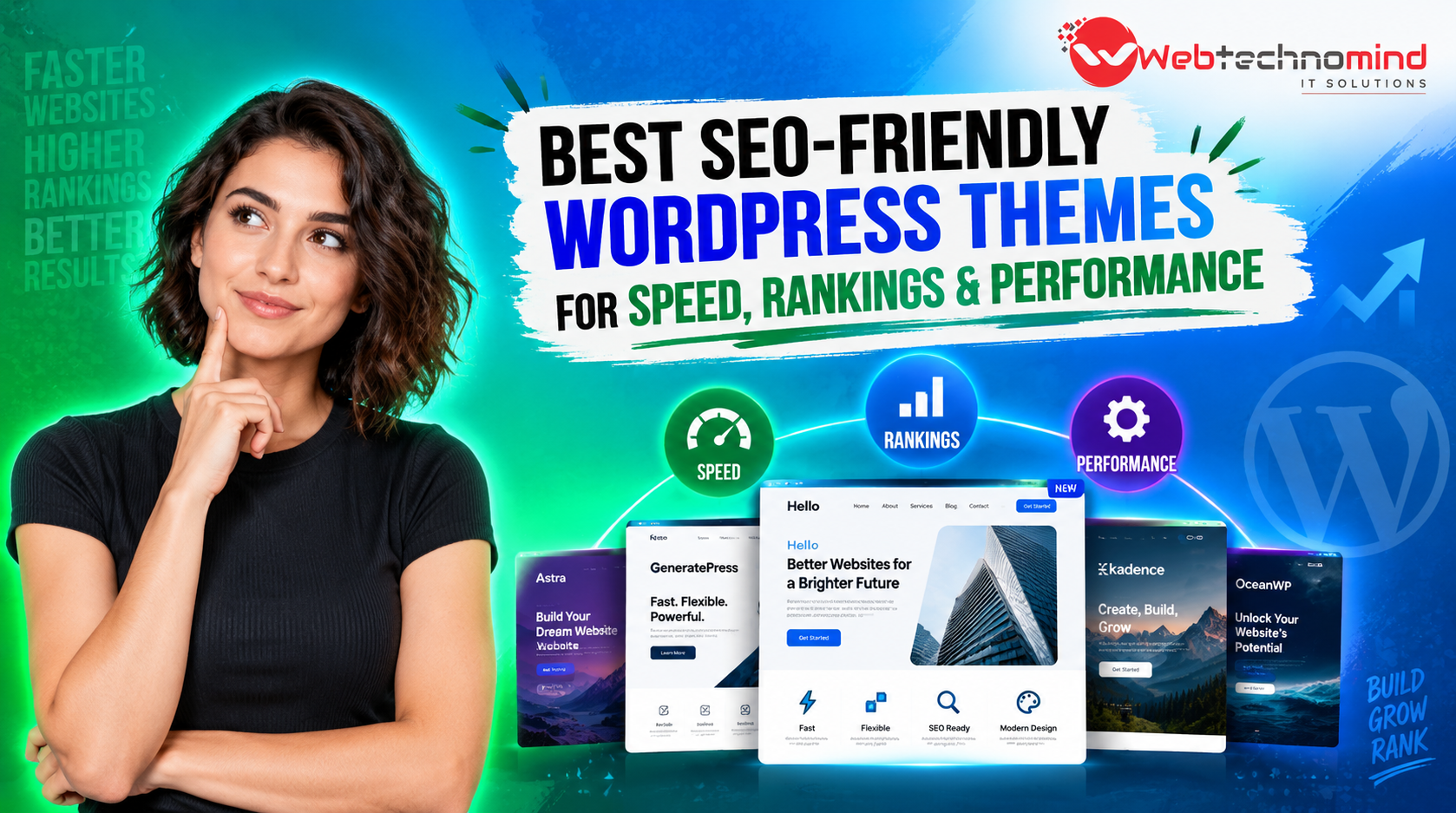







Choosing the right WordPress theme is one of the most important decisions when building a website focused on SEO, speed, rankings, and conversions. A visually attractive theme is not always a performance-friendly theme. If a theme loads unnecessary scripts, stylesheets, animations, or third-party resources, it can make your website slower and negatively affect the user experience.
For businesses, bloggers, agencies, eCommerce websites, and publishers, the ideal theme should combine fast loading speed, clean code, responsive design, SEO compatibility, and easy customization.
WordPress currently offers thousands of themes, including both classic and block-based themes. The official WordPress theme directory provides filters for features such as block editing, accessibility, responsive layouts, and more.
In this guide, we explore some of the best SEO-friendly WordPress themes for speed, rankings, and website performance.
An SEO-friendly WordPress theme should provide more than an attractive design. It should create a strong technical foundation for search engine optimization.
Important features include:
Google considers page experience and performance important for users, while WordPress itself continues to introduce performance improvements across its core platform, themes, and plugins.
GeneratePress is one of the most popular choices for websites where performance and SEO are priorities.
Its lightweight approach makes it suitable for blogs, business websites, affiliate websites, agencies, and content-focused websites. Instead of forcing users to load a large number of features, GeneratePress allows website owners to add functionality according to their requirements.
GeneratePress is particularly useful when your primary objective is to build a clean website without unnecessary design elements affecting performance.
Astra is another widely used WordPress theme for businesses, blogs, portfolios, agencies, and online stores.
One of Astra’s biggest advantages is its combination of performance and design flexibility. Website owners can create professional layouts while maintaining control over the site’s structure and features.
Astra works well with popular WordPress page builders and can be customized for different industries.
For businesses looking for a balance between design, SEO, and performance, Astra is a strong option.
Kadence has become another popular choice for users looking for a modern WordPress theme without sacrificing performance.
It offers flexible typography, headers, footers, layouts, and design controls. This makes it useful for corporate websites, blogs, agencies, eCommerce stores, and professional service websites.
Its compatibility with the WordPress block editor also makes it suitable for users who prefer native WordPress editing.
Modern WordPress block themes deserve special attention. Block themes allow users to edit major parts of a website—including headers, footers, navigation, templates, and content—using blocks and the Site Editor.
This can make website management much more flexible.
However, it is important to remember that being a block theme does not automatically mean a website will be faster. WordPress performance benchmarks have shown that performance can vary depending on the theme and implementation.
Therefore, always test the actual website rather than judging performance only from the theme type.
For users who prefer a WordPress-native solution, Twenty Twenty-Five is worth considering.
Official WordPress themes have the advantage of being maintained within the WordPress ecosystem and are designed to work closely with WordPress core functionality.
It can be a practical choice for blogs, publishers, personal websites, and content-focused businesses that do not require an extremely complex design system.
Hello Elementor is designed as a minimal foundation for websites built with Elementor.
Its stripped-down approach can be useful when users want to create custom designs without starting with a feature-heavy theme.
However, performance depends heavily on how the website is built. Adding too many Elementor widgets, animations, plugins, fonts, and third-party scripts can increase page weight.
Therefore, Hello Elementor works best when combined with disciplined website optimization.
Your theme does not directly determine whether your website ranks #1 on Google. SEO involves many factors, including content quality, search intent, backlinks, technical SEO, internal linking, website authority, and user experience.
However, the theme can influence the technical foundation of your website.
A poorly optimized theme can generate excessive CSS and JavaScript, create layout shifts, increase loading time, and make mobile browsing difficult.
A lightweight theme can make optimization easier.
When evaluating a WordPress theme, pay attention to Core Web Vitals, particularly:
A theme that loads unnecessary resources can make these metrics harder to optimize.
Before installing a theme, consider these factors:
Do not rely only on a theme’s marketing claims. Install the theme on a test website and measure performance using tools such as PageSpeed Insights and Lighthouse.
Google predominantly uses the mobile version of websites for indexing, so your theme should work smoothly on smartphones and tablets.
A theme offering hundreds of animations, sliders, widgets, and design elements may sound attractive, but unnecessary features can increase page weight.
Your theme should work properly with your SEO, caching, security, analytics, and performance plugins.
Choose a theme that is actively maintained. WordPress continuously evolves, so themes should also receive compatibility, security, and performance updates.
A clean website can be both professional and fast. You do not need dozens of animations or large visual effects to create an impressive website.
For SEO-focused blogs: GeneratePress, Astra, and Kadence are strong choices.
For business websites: Astra, Kadence, and GeneratePress offer a good balance between flexibility and performance.
For Elementor websites: Hello Elementor can provide a lightweight starting point.
For content publishers: GeneratePress and native WordPress themes can work well.
For WooCommerce: Astra and Kadence are worth considering because of their eCommerce-focused capabilities.
Choosing the best SEO-friendly WordPress theme is about finding the right balance between appearance, functionality, speed, and technical performance.
GeneratePress, Astra, Kadence, Hello Elementor, and modern WordPress block themes can all be excellent choices when properly configured. However, no theme can guarantee higher Google rankings by itself.
The best approach is to combine a lightweight theme with high-quality content, technical SEO, optimized images, fast hosting, caching, clean internal linking, mobile optimization, and regular performance testing.
WordPress itself continues to improve its performance infrastructure, while its theme ecosystem provides thousands of options for different types of websites.
For businesses serious about organic traffic, the goal should not simply be choosing a “fast theme.” Instead, choose a theme that provides a clean foundation and then continuously optimize the complete website for speed, usability, search visibility, and conversions.
Read More



A professional website is no longer optional for businesses that want to establish a strong online presence. Whether...

Migrating a WordPress website can be necessary when changing hosting providers, moving to a new domain, redesigning a...

Choosing the best WordPress hosting in 2026 is more important than simply looking for the cheapest monthly plan....
WordPress powers millions of websites worldwide, making it one of the most popular content management systems for businesses,...