Retargeting Ads Strategy: How to Recover Lost Visitors & Increase Conversions
- By admin
- Aug 25, 2026

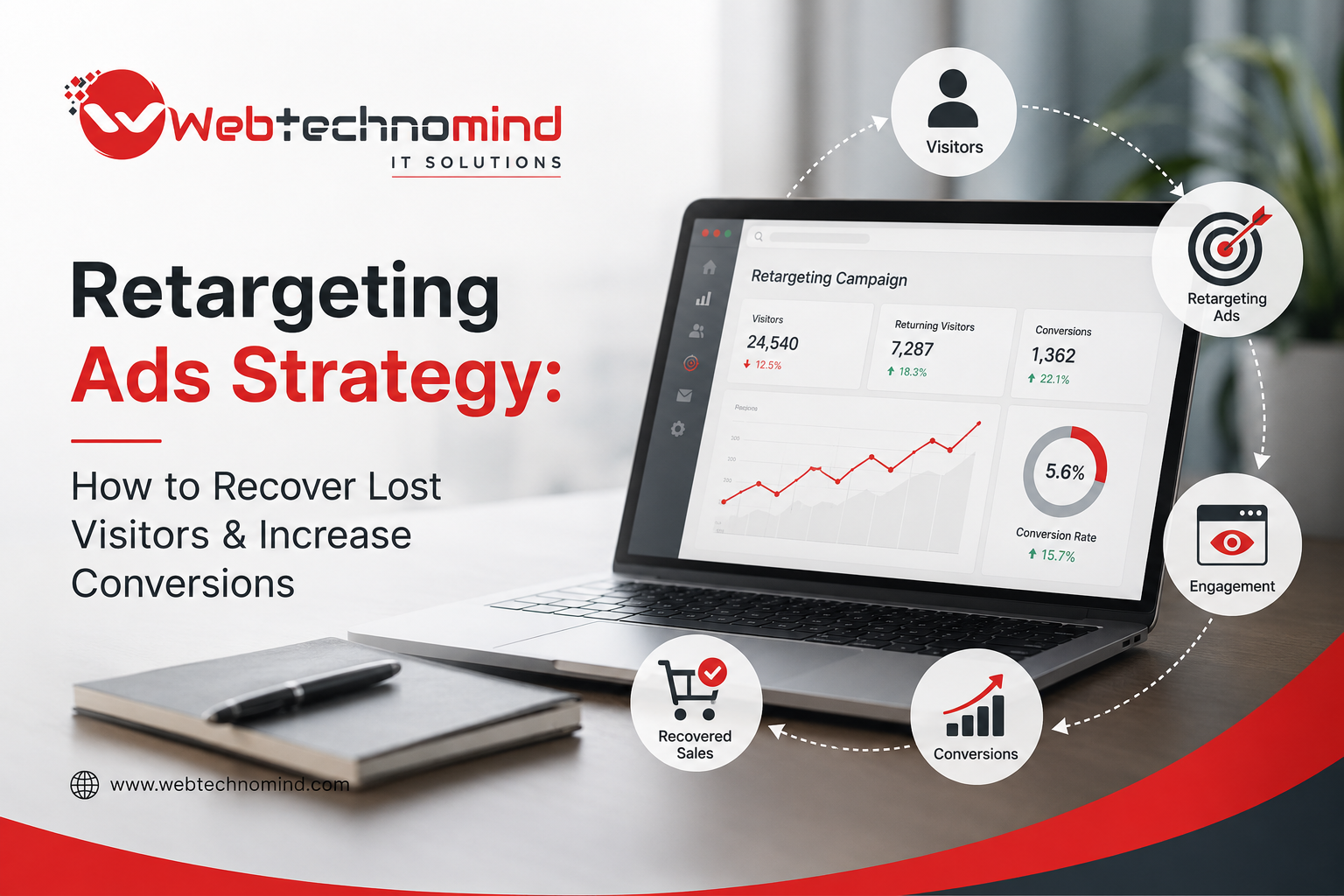







Most website visitors do not convert on their first visit. They may browse your products, compare prices, read your services, add an item to their cart, or simply leave because they are not ready to make a decision. This does not necessarily mean they are lost customers.
With the right retargeting ads strategy, businesses can reconnect with these visitors, bring them back to the website, and encourage them to complete the action they originally considered. Retargeting is one of the most effective ways to improve conversion rates because it focuses advertising on people who have already shown interest in your brand.
In this guide, we will explore how retargeting ads work, why they matter, and how businesses can use them to recover lost visitors and increase conversions.
Retargeting ads are online advertisements shown to people who have previously interacted with your website, app, social media profile, or digital content.
For example, imagine someone visits your online store and looks at a pair of shoes but leaves without purchasing. Later, while browsing another website or social media platform, they may see an advertisement featuring the same shoes or a related offer.
That is retargeting.
Instead of advertising to a completely new audience, you are reconnecting with people who already know your business. This makes retargeting particularly valuable for businesses with longer buying journeys or higher-value products and services.
A visitor who leaves your website is not necessarily uninterested. They may have been distracted, researching competitors, waiting for payday, comparing options, or simply not ready to purchase.
Retargeting gives your business another opportunity to engage with them.
One of the biggest advantages of retargeting is audience relevance. You are advertising to people who have already demonstrated interest, which can make your campaigns more focused than broad awareness campaigns.
Retargeting can help businesses:
However, successful retargeting requires more than repeatedly showing the same advertisement to everyone.
One of the most important steps in building an effective retargeting ads strategy is audience segmentation.
Not every website visitor has the same level of buying intent.
For example, someone who visited your homepage for 10 seconds should not receive the same advertisement as someone who viewed a product five times or added it to their cart.
Consider creating different audience segments such as:
Homepage visitors:
Use educational or brand-focused advertisements to build familiarity.
Product or service page visitors:
Show specific products, benefits, customer reviews, or demonstrations.
Cart abandoners:
Remind users about their unfinished purchase and provide additional motivation to complete it.
High-intent visitors:
Target users who spent significant time on your website, visited multiple pages, or repeatedly viewed a particular product.
Existing customers:
Promote complementary products, upgrades, subscriptions, or repeat purchases.
Audience segmentation allows you to deliver more relevant messages instead of using a one-size-fits-all campaign.
A common retargeting mistake is showing the same advertisement to every visitor.
Instead, your messaging should reflect where the customer is in the buying journey.
Someone who is still researching needs information and reassurance. Someone who has already added a product to their cart may simply need a reminder.
For example:
Awareness stage:
“Discover how our solution can simplify your business.”
Consideration stage:
“See why businesses choose our solution.”
Decision stage:
“Ready to get started? Book your free consultation today.”
This approach makes your retargeting campaigns feel more personalized and relevant.
Your audience already knows your brand, so your advertisement needs to give them a reason to return.
Strong retargeting creatives can include:
Your ad should answer one simple question:
Why should the visitor come back now?
For example, instead of simply saying “Visit Our Website,” a stronger message could be:
“Still comparing your options? See how our solution helped businesses reduce operational costs.”
Specific messaging gives users a stronger reason to click.
For eCommerce businesses, abandoned carts represent one of the biggest retargeting opportunities.
A customer may add products to their cart but leave before completing the purchase. Retargeting can remind them about the products they were interested in.
Your campaign might include messages such as:
“Still thinking about it? Your items are waiting.”
You can also test incentives such as free shipping, limited-time discounts, or additional benefits. However, discounts should be used carefully. If customers learn that abandoning their cart always results in an offer, they may intentionally wait for one.
Seeing the same advertisement repeatedly can quickly become annoying.
This is known as ad fatigue.
If a person sees your advertisement dozens of times within a short period, they may develop a negative perception of your brand rather than becoming more likely to convert.
Use frequency controls where available and rotate different creatives regularly.
You can also adjust your retargeting window based on customer behavior. A high-intent visitor may deserve more frequent advertising shortly after their visit, while a casual visitor may require a longer and lighter retargeting sequence.
One of the simplest ways to waste retargeting budget is continuing to advertise a product or service to someone who has already purchased it.
Set up conversion-based exclusions whenever possible.
For example, after a customer purchases a product, remove them from the campaign promoting that exact product. You can instead move them into a customer retention campaign promoting accessories, upgrades, related services, or repeat purchases.
This makes your advertising more efficient and improves the customer experience.
Retargeting does not have to depend on one advertising channel.
Depending on your audience and business model, you can test platforms such as Google Ads, Meta Ads, LinkedIn Ads, and other advertising networks.
For B2C brands, Meta and Google can provide powerful retargeting opportunities.
For B2B companies, LinkedIn can be particularly useful for reaching professional audiences who have previously interacted with your website or content.
The key is not to advertise everywhere simply because you can. Identify where your audience spends time and allocate budget based on measurable performance.
A strong retargeting campaign cannot compensate for a poor landing page.
If someone clicks your advertisement and lands on a slow, confusing, or irrelevant page, the opportunity may be lost again.
Your landing page should:
For example, if your retargeting advertisement promotes a specific service, send visitors directly to that service page rather than your generic homepage.
Tracking impressions alone does not tell you whether your campaign is successful.
Important retargeting metrics include:
Look beyond clicks. A campaign with fewer clicks but more qualified conversions may be much more profitable than a campaign generating large amounts of inexpensive traffic.
There is no single retargeting strategy that works for every business.
Test different:
For example, you might discover that testimonials outperform discounts, or that video ads generate more conversions than static images.
Use campaign data to identify what works and gradually move more budget toward your strongest combinations.
Retargeting ads provide businesses with an opportunity to reconnect with visitors who have already demonstrated interest but did not convert.
The most effective retargeting ads strategy combines audience segmentation, personalized messaging, compelling creatives, frequency management, conversion tracking, and continuous testing.
Instead of treating every website visitor as a lost opportunity, use retargeting to continue the conversation. When the right message reaches the right person at the right stage of the buying journey, previous visitors can become leads, customers, and long-term brand advocates.
Ultimately, successful retargeting is not about showing more advertisements. It is about showing more relevant advertisements to the people most likely to take action.
Read More
Generating leads through Meta Ads can be one of the most effective ways for businesses to reach potential...
Running Facebook and Instagram ads without accurate conversion tracking is like driving with no dashboard. You may see...

Meta Conversions API Setup Guide: Improve Tracking Accuracy After iOS Privacy Updates Meta advertising has changed significantly as...
Instagram advertising has become one of the most effective ways for businesses to reach potential customers, build brand...