Meta Conversions API Setup Guide: Improve Tracking Accuracy After iOS Privacy Updates
- By admin
- Aug 24, 2026








Meta Conversions API Setup Guide: Improve Tracking Accuracy After iOS Privacy Updates
Meta advertising has changed significantly as privacy regulations, browser restrictions, and Apple’s iOS privacy updates have reduced the amount of data marketers can collect through traditional browser-based tracking. For businesses running Facebook and Instagram advertising, this can make it harder to accurately measure conversions, attribute leads, and understand which campaigns are actually generating results.
One of the most important solutions is Meta Conversions API (CAPI).
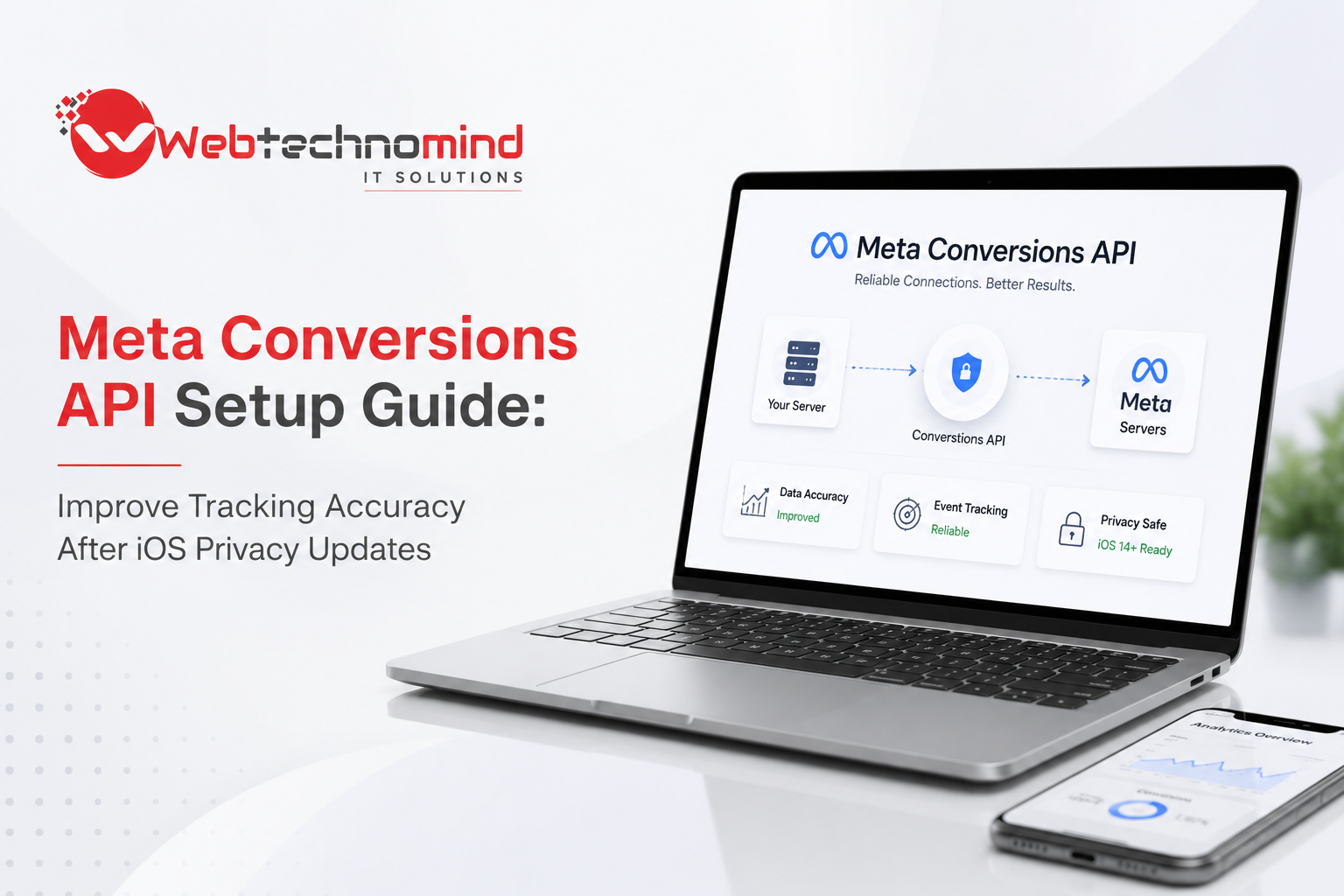
Meta Conversions API allows businesses to send conversion and customer-event data directly from their website server or other trusted systems to Meta. Instead of relying entirely on the browser and Meta Pixel, CAPI creates a more reliable server-side connection for sharing important marketing events.
This guide explains what Meta Conversions API is, why it matters after iOS privacy updates, and how businesses can set it up effectively.
Meta Conversions API is a server-side tracking technology that sends website events directly from your server to Meta.
Traditionally, Meta Pixel collects events such as:
However, browser restrictions, ad blockers, cookie limitations, and privacy changes can prevent some of these events from being recorded.
With Conversions API, your server can send relevant events directly to Meta. This gives advertisers another data-sharing method alongside the Meta Pixel.
The goal is not simply to replace the Pixel. Instead, the strongest implementation usually combines Meta Pixel + Conversions API to create a more complete measurement system.
Apple introduced App Tracking Transparency (ATT) with iOS 14.5, requiring apps to request permission before tracking users across apps and websites.
This significantly changed how Meta could receive and use advertising data from iOS users.
For marketers, the impact can include:
It is important to understand that Conversions API does not bypass Apple’s privacy requirements. It is designed to provide a more reliable first-party data connection while supporting privacy-conscious measurement.
The Meta Pixel operates primarily through the user’s browser, while Conversions API sends events from your server.
The Pixel is useful for collecting browser-based activity and supporting Meta’s advertising features. CAPI provides an additional server-side signal that can be less affected by browser limitations.
For example, imagine someone clicks a Facebook ad, visits your website, and submits a lead form.
The browser may fail to send the event because of browser restrictions or tracking prevention. If your server records the lead and sends the event through Conversions API, Meta may still receive the relevant conversion signal, subject to consent, configuration, and attribution limitations.
Using both systems can therefore improve event coverage and measurement quality.
Server-side events are less dependent on browser conditions. This can help businesses capture important conversion signals that might otherwise be lost.
CAPI allows businesses to send structured first-party event information directly from their backend systems.
For example, an eCommerce business can send purchase information after an order has successfully been processed.
Meta’s advertising system uses conversion signals to optimize campaigns. Better-quality event data can help provide stronger signals for optimization, depending on campaign setup and data volume.
Customers may interact with multiple pages, devices, and marketing channels before converting. Server-side tracking can help businesses build a more dependable event measurement framework.
Browser-based tracking will continue to face privacy and technical limitations. A server-side approach gives businesses greater control over how their first-party conversion data is shared.
The exact implementation depends on your website platform, CRM, eCommerce system, and technical infrastructure. However, the overall setup process generally follows these steps.
Before implementing CAPI, make sure your Meta Pixel is correctly installed.
Check whether important events such as:
are being recorded correctly.
Your Pixel should be functioning properly before you attempt to improve tracking through server-side events.
Do not send every possible website action to Meta simply because you can.
Start with the events that directly support your advertising goals.
For a lead-generation website, these could include:
PageView → Contact → Lead
For an eCommerce website:
ViewContent → AddToCart → InitiateCheckout → Purchase
For a SaaS company:
PageView → Signup → Trial → Subscription
Clearly defining your conversion funnel makes the implementation easier and improves the usefulness of your data.
Meta Conversions API can be implemented in several ways.
Depending on your technology stack, you may use:
Businesses using platforms such as Shopify or other major eCommerce systems may have partner-based options. Custom websites and applications may require developer involvement.
Your backend should send relevant events to Meta when meaningful customer actions occur.
For example, when a customer completes a purchase, your server can send information such as:
The data should be handled carefully and according to applicable privacy and data-protection requirements.
If you use both Meta Pixel and Conversions API, the same conversion may be sent through both systems.
Without proper deduplication, Meta could potentially interpret one conversion as two events.
This is why event_id is extremely important.
For example, the browser Pixel and server can send the same purchase with a matching event ID. Meta can then recognize that both signals represent the same conversion.
Proper event deduplication is one of the most important technical elements of a reliable CAPI implementation.
After implementation, use Meta’s event diagnostics and testing tools to check whether events are being received correctly.
Review:
Do not assume that CAPI is working correctly simply because events appear in your account.
Testing is essential.
One of the important considerations when implementing CAPI is Event Match Quality.
Meta can use customer information to help match conversion events with people on its platform. Depending on your legal basis and consent framework, this can include appropriately handled information such as email addresses, phone numbers, IP addresses, or other permitted identifiers.
Customer information should be processed securely and according to applicable privacy laws and your company’s privacy policies.
Better-quality event data can improve Meta’s ability to associate conversions with advertising interactions.
Many businesses implement Conversions API but still experience inaccurate reporting because of configuration problems.
Using Pixel and CAPI without event deduplication can create duplicate conversion signals.
Sending large amounts of irrelevant data can make your tracking structure unnecessarily complicated.
Focus on meaningful business events.
CAPI is not a method for bypassing privacy requirements. Businesses should establish appropriate consent, data governance, and compliance processes.
Missing or incorrectly formatted values can reduce the usefulness of your conversion data.
A technical implementation should always be tested before relying on it for campaign optimization and reporting.
For businesses that rely heavily on Meta advertising, Conversions API is increasingly important as browser-based tracking becomes more restricted.
However, CAPI should not be viewed as a magic solution that restores all historical tracking capabilities. Privacy changes have permanently altered digital advertising measurement.
Instead, businesses should build a modern measurement strategy around:
First-party data + Meta Pixel + Conversions API + privacy compliance + accurate analytics
This approach provides a stronger foundation for advertising measurement in a privacy-focused digital environment.
The advertising ecosystem is moving away from unrestricted browser-based tracking. Apple’s iOS privacy changes, browser restrictions, cookie limitations, and evolving privacy regulations have made accurate conversion measurement more challenging.
Meta Conversions API gives advertisers a valuable server-side tracking option that works alongside Meta Pixel.
When implemented correctly, CAPI can improve event coverage, strengthen conversion signals, reduce dependence on browser tracking, and provide Meta with better-quality data for campaign measurement and optimization.
The most important thing is to focus on accuracy rather than simply collecting more data. Define your important conversion events, implement Pixel and CAPI together, use event IDs for deduplication, validate your server-side events, and maintain strong privacy practices.
For businesses investing heavily in Facebook and Instagram advertising, a properly configured Meta Conversions API setup can become an important part of a modern, privacy-conscious tracking strategy.
Read More

Running Facebook and Instagram ads without accurate conversion tracking is like driving with no dashboard. You may see...
Instagram advertising has become one of the most effective ways for businesses to reach potential customers, build brand...