CRM Automation Guide: How to Automate Sales, Marketing & Customer Support Using AI
- By admin
- Sep 03, 2026

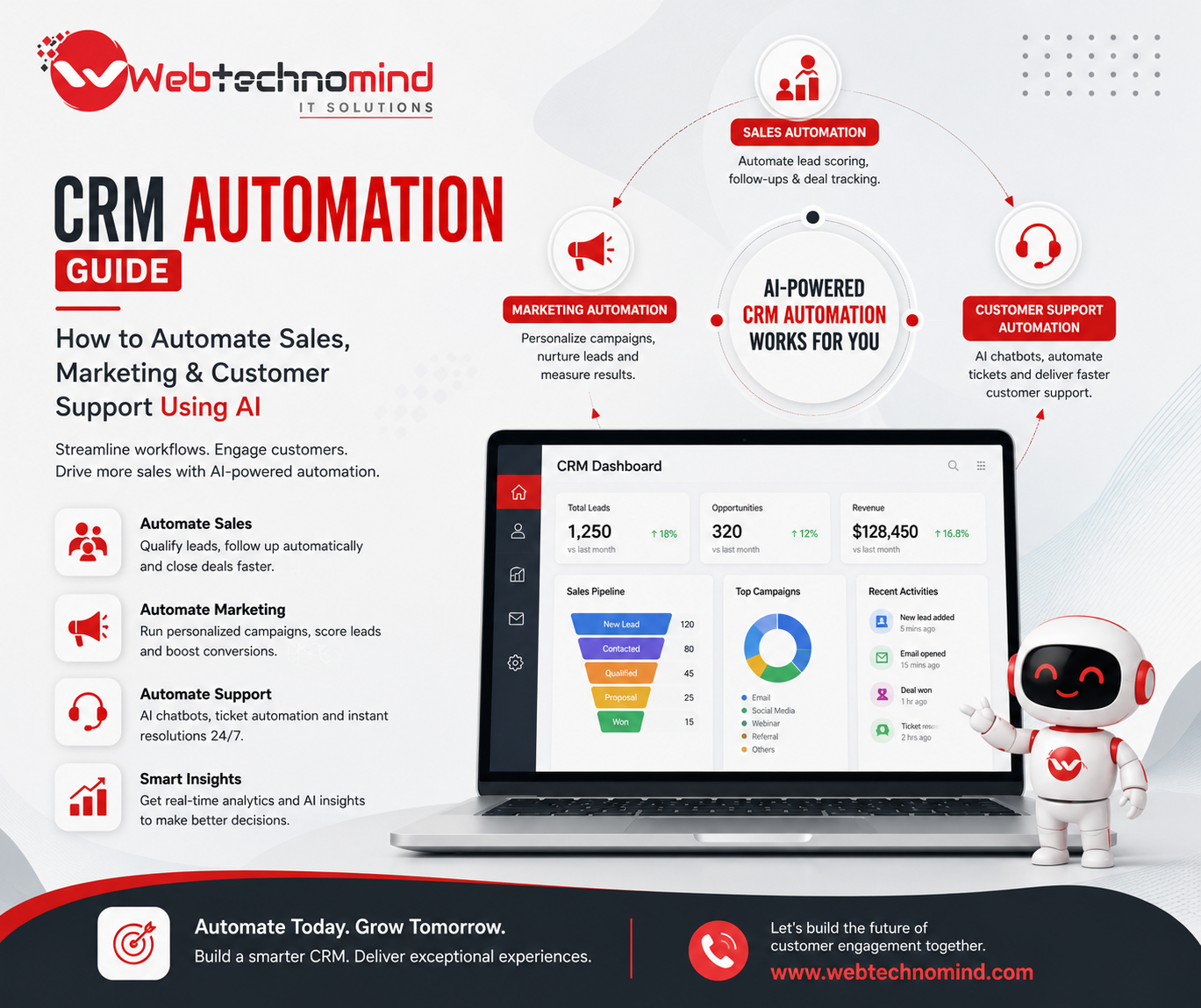







Managing customer relationships manually can quickly become difficult as a business grows. Sales teams need to follow up with leads, marketing teams need to nurture prospects, and customer support teams must respond to questions quickly. When these activities are handled across spreadsheets, emails, messaging apps, and disconnected tools, important information can easily get lost.
This is where CRM automation can make a major difference.
An AI-powered CRM can automate repetitive tasks, organize customer information, identify opportunities, personalize communication, and help teams make faster decisions. Instead of replacing human teams, AI allows employees to spend less time on repetitive administrative work and more time building relationships and closing deals.
In this guide, we will explore how businesses can use AI-powered CRM automation to automate sales, marketing, and customer support.
CRM automation is the use of software, workflows, rules, and artificial intelligence to automate repetitive customer relationship management activities.
A traditional CRM primarily stores customer information, sales activities, contact details, and communication history. An automated CRM goes further by taking actions automatically based on predefined rules or AI-generated insights.
For example, when a new visitor submits a form, an automated CRM can:
This reduces manual work while ensuring that leads and customers receive timely communication.
Artificial intelligence is making CRM systems more intelligent and proactive.
Traditional automation generally follows predefined rules such as “if this happens, do that.” AI-powered automation can analyze large amounts of customer data, recognize patterns, understand conversations, generate content, and recommend the next best action.
AI can help businesses:
The result is a CRM system that does more than store data—it actively helps teams manage customer relationships.
Sales automation is one of the most valuable applications of an AI-powered CRM.
AI-powered CRM systems can collect leads from websites, landing pages, social media campaigns, chatbots, forms, and other sources.
Instead of manually entering customer information, the CRM automatically creates a customer profile and records the source of the lead.
Not every lead has the same potential.
AI can analyze factors such as website activity, company information, previous interactions, email engagement, purchase history, and other available data to identify high-value prospects.
Sales representatives can then focus their time on leads that are more likely to convert.
One of the biggest challenges for sales teams is inconsistent follow-up.
CRM automation can automatically create reminders and trigger emails or messages based on customer behavior.
For example, if a prospect downloads a product guide but does not contact the sales team, the CRM can automatically send a relevant follow-up message after a predefined period.
AI-powered CRM software can automatically update deal stages based on sales activity, assign tasks, alert managers about delayed opportunities, and identify deals that may require immediate attention.
This gives sales managers greater visibility into the pipeline without requiring constant manual updates.
CRM automation and marketing automation work particularly well together.
AI can analyze customer information and engagement history to create more relevant marketing communication.
Instead of sending the same message to every customer, businesses can create different campaigns for new leads, returning customers, inactive customers, high-value clients, and prospects who are close to purchasing.
Many prospects are not ready to buy immediately.
AI-powered CRM automation can place these leads into nurturing workflows and deliver useful content at appropriate stages of the customer journey.
For example:
New Lead → Educational Content → Product Information → Case Study → Sales Follow-Up → Conversion
This allows businesses to nurture prospects without manually managing every interaction.
AI can analyze customer data and identify meaningful segments based on behavior, preferences, purchase history, engagement, or other business-specific factors.
Better segmentation allows marketers to create more targeted campaigns and improve conversion rates.
Customer support is another area where CRM automation can significantly improve efficiency.
AI chatbots can answer common customer questions 24/7. They can help customers find information, check order status, understand products, or initiate support requests.
When a question requires human expertise, the chatbot can transfer the conversation to a support representative with relevant customer information and conversation history.
AI can automatically categorize incoming support requests, identify urgency, assign tickets to the correct department, and prioritize important issues.
For example, a billing issue can automatically be routed to the finance support team while a technical problem is assigned to technical support.
Support agents often spend significant time reading previous conversations.
AI can summarize customer interactions and provide agents with the most important information before they respond. This helps reduce response time and makes customer service more consistent.
AI can analyze customer messages to identify whether a customer appears satisfied, frustrated, confused, or angry.
Businesses can use this information to prioritize sensitive cases and escalate conversations when necessary.
Successful CRM automation requires more than simply installing software. Businesses should design workflows around their actual customer journey.
Start by identifying activities that consume employee time but do not require significant human decision-making.
Examples include:
Understand how prospects move from first interaction to purchase and eventually to customer support or repeat business.
This helps determine where automation can create the greatest impact.
Create workflows based on customer actions.
For example:
If a lead submits a form → create CRM record → assign salesperson → send welcome email → schedule follow-up.
Not every workflow needs artificial intelligence.
Use AI where it can improve decision-making, personalization, prediction, or communication. Simple tasks can often be handled with traditional automation rules.
CRM automation should be continuously improved.
Track metrics such as lead response time, conversion rate, customer satisfaction, sales cycle length, email engagement, support resolution time, and automation errors.
Businesses can gain several advantages by implementing CRM automation effectively:
Automation is powerful, but poorly designed automation can create more problems than it solves.
Avoid automating every customer interaction. Customers still value human conversations, particularly when dealing with complex or sensitive issues.
Businesses should also avoid using poor-quality customer data, creating overly complicated workflows, sending excessive automated messages, or failing to monitor automation performance.
The best strategy is to automate repetitive processes while keeping humans involved where judgment, empathy, creativity, and relationship-building are important.
The future of CRM is moving toward intelligent systems that can proactively assist sales, marketing, and customer service teams.
Instead of simply reporting what happened, AI-powered CRM platforms are increasingly being used to recommend what should happen next.
For example, an AI system may identify a high-value lead, explain why the lead is important, draft a personalized message, recommend the best follow-up time, and create the necessary task for a salesperson.
This shift from CRM as a database to CRM as an intelligent business assistant could significantly change how companies manage customer relationships.
CRM automation is becoming an important part of modern business operations. By combining CRM software with artificial intelligence, businesses can automate sales processes, personalize marketing campaigns, improve customer support, and make better use of customer data.
The goal should not be to automate everything. Instead, businesses should identify repetitive processes where automation can save time and use AI where intelligent analysis and personalization can provide additional value.
When implemented correctly, AI-powered CRM automation can help businesses respond faster, nurture leads more effectively, improve customer experiences, and give employees more time to focus on high-value work.
For businesses looking to scale efficiently, CRM automation is no longer simply a technology upgrade—it can become a strategic advantage.
Read More


Artificial intelligence is rapidly changing how businesses handle content, customer support, software development, research, and everyday operations. Among...
Artificial intelligence is changing how businesses handle repetitive tasks, customer communication, data processing, content creation, and decision-making. But...

Artificial intelligence has moved from being an emerging technology to becoming a practical part of modern software development....
Artificial intelligence has moved beyond experimentation and become a practical business technology. From creating content and analyzing information...