AI Content Creation Guide 2026: How to Create SEO-Friendly Content That Ranks in Google & AI Search
- By admin
- Aug 31, 2026

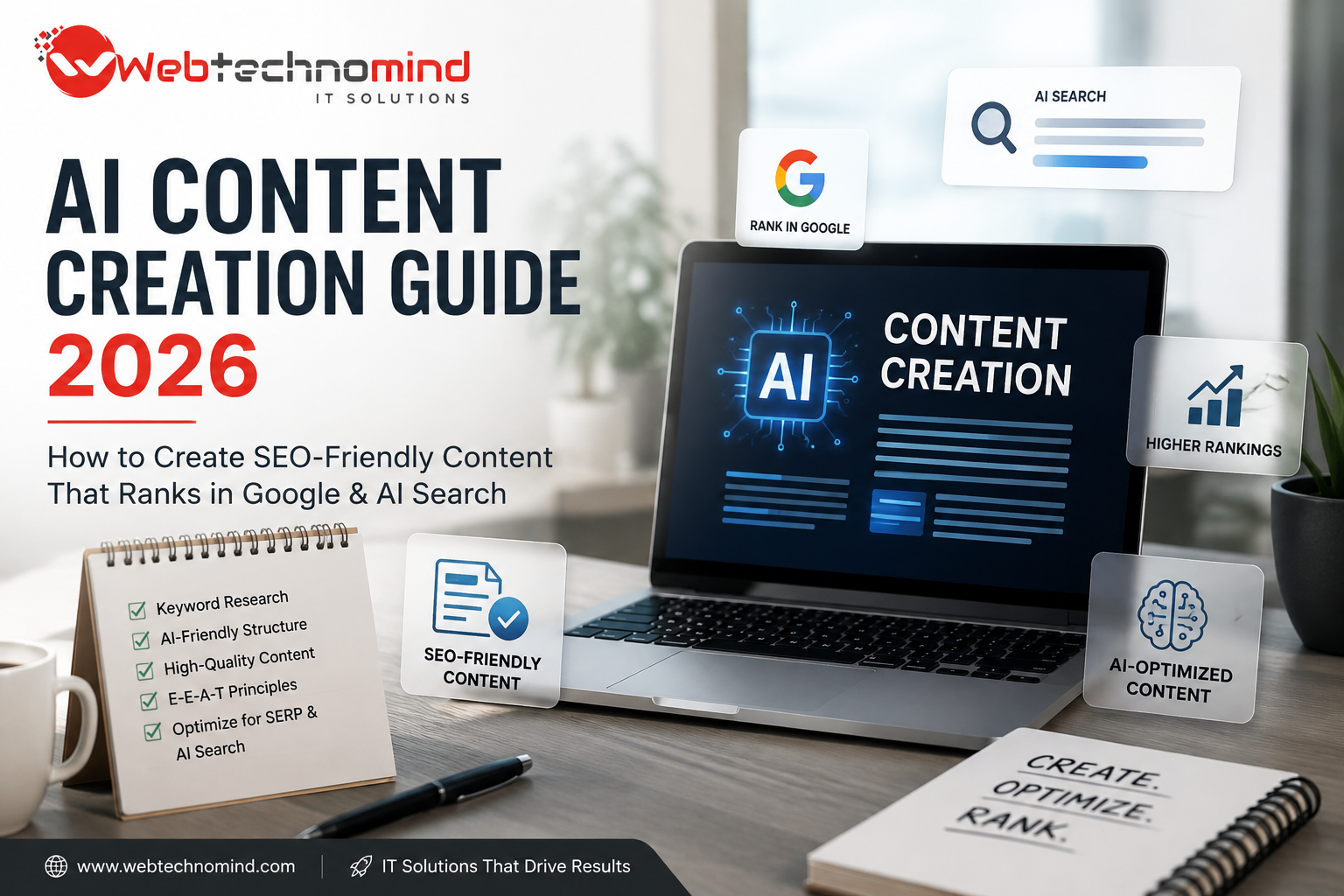







Artificial intelligence has changed how businesses create content. In 2026, AI tools can help marketers research topics, generate outlines, draft articles, analyze search intent, and scale content production faster than ever.
But creating content with AI is not the same as creating content that performs well.
Search engines are becoming better at identifying useful, original, trustworthy content, while AI search platforms are changing how users discover information. Instead of simply displaying a list of links, AI-powered search experiences can summarize information and provide direct answers.
That means businesses need a smarter approach to content creation—one that combines AI efficiency with human expertise, originality, search intent, and strong SEO fundamentals.
This guide explains how to create SEO-friendly AI content in 2026 that can perform in traditional Google search as well as emerging AI search experiences.
AI content creation is the process of using artificial intelligence tools to assist with researching, planning, writing, optimizing, and improving digital content.
AI can help create:
However, AI should be treated as a productivity tool rather than a replacement for expertise.
The strongest content strategy in 2026 is AI-assisted, human-reviewed content. AI can accelerate the process, while human writers and subject-matter experts provide experience, opinions, examples, accuracy, and originality.
Search behavior is changing rapidly. Users increasingly expect fast, accurate answers rather than generic information.
Google continues to evolve its search experience, while AI-powered search platforms can interpret questions conversationally and synthesize information from multiple sources.
This creates a new challenge for content marketers.
Your content needs to be:
Simply inserting keywords into an AI-generated article is no longer an effective SEO strategy.
Before generating an article, understand what the user actually wants.
Search intent generally falls into four categories:
For example, someone searching for “what is AI content creation” probably wants an explanation. Someone searching for “best AI content writing tools” may be comparing solutions.
Your content should satisfy the intent behind the query instead of focusing only on the keyword.
Before asking an AI tool to write an article, create a detailed content brief.
Your brief should include:
A strong brief gives AI a clear direction and reduces the risk of producing generic content.
One of the biggest mistakes marketers make is using AI only to generate paragraphs.
AI can be much more useful during the research and planning stage.
Use AI to identify:
However, important facts should be verified using reliable sources. AI-generated information can sometimes be outdated, incomplete, or incorrect.
A well-structured article is easier for users and search engines to understand.
Use a logical hierarchy:
H1: Main article title
H2: Major sections
H3: Supporting topics
Keep paragraphs relatively short and use bullet points, numbered lists, tables, and examples where appropriate.
For example, an article about AI SEO could include:
Good structure improves readability and helps search engines understand relationships between topics.
Keywords still matter, but modern SEO is not about repeating the same phrase dozens of times.
Include the primary keyword naturally in important areas such as:
Also use related terms and entities.
For example, an article targeting “AI content creation” could naturally discuss:
The goal is to demonstrate comprehensive topic coverage rather than keyword stuffing.
This is one of the most important principles of AI content creation in 2026.
AI can generate grammatically correct information, but generic content often sounds similar across websites.
Add something AI cannot automatically manufacture about your business:
For example, instead of simply explaining that website speed matters, explain how improving image optimization, lazy loading, and page structure affected a real website project.
Original experience makes content more useful and differentiated.
AI search introduces another layer of optimization.
AI systems need to understand your content before they can potentially use it as a source.
Make your content easy to interpret by using:
When answering a question, provide a clear answer first and then explain it in greater depth.
For example:
What is AI content creation?
AI content creation is the use of artificial intelligence to assist with researching, planning, producing, and optimizing digital content.
Then expand on the concept.
This structure is useful for both human readers and AI-driven search systems.
High-quality content should establish why readers should trust the information.
Include appropriate author information, company expertise, credentials, practical experience, references to reliable information, and transparent explanations where relevant.
For business websites, strong content should also make it clear who is behind the information.
A technology agency discussing AI development, for example, can strengthen its content by demonstrating real experience with AI integrations, software development, automation, and digital products.
Never publish an AI-generated draft without reviewing it.
A human editor should check:
Remove generic phrases and unnecessary explanations.
The final article should sound like it was written for a specific audience—not like a machine created it for everyone.
Frequently asked questions can improve the usefulness of an article and address long-tail searches.
For an AI content article, questions could include:
AI-assisted content can perform well when it provides genuine value, is accurate, original, relevant, and created to satisfy users rather than simply manipulate rankings.
Yes, AI-assisted content can rank when it meets quality and relevance expectations. The important factor is the value of the content, not simply whether AI was used during production.
Add original insights, real examples, specific experiences, unique opinions, useful data, and a natural brand voice. Always edit the AI draft before publishing.
Create clear, comprehensive, well-structured content that directly answers questions and demonstrates expertise. Use descriptive headings, concise explanations, relevant entities, and trustworthy information.
AI makes content production faster, but careless automation can create serious problems.
Avoid:
More content does not automatically mean better SEO.
One genuinely useful article can outperform dozens of thin pages.
The most effective approach is a combination of AI + SEO + human expertise.
A practical workflow looks like this:
Research → Search Intent → Content Brief → AI Assistance → Human Expertise → SEO Optimization → Fact Checking → Editing → Publishing → Performance Analysis
AI should make your content team faster, not make your content less valuable.
After publishing, monitor impressions, clicks, rankings, engagement, conversions, and user behavior. Use that data to update and improve the article over time.
AI content creation is no longer simply about generating articles quickly. In 2026, the real competitive advantage comes from creating content that is useful to people and understandable to both traditional and AI-powered search systems.
Use AI to accelerate research, ideation, outlining, drafting, and optimization—but add human judgment, experience, originality, and fact-checking before publishing.
The goal is not to create the most AI-generated content.
The goal is to create the most useful content with AI as an advantage.
Businesses that combine intelligent automation with strong SEO fundamentals, genuine expertise, and a human editorial process will be better positioned to compete in both Google search and the rapidly evolving world of AI search.
Read More




Introduction Publishing content consistently is one of the most effective ways to build long-term organic visibility. However, simply...

Content marketing has changed significantly. Publishing a few keyword-focused blog posts every month is no longer enough to...

Introduction Blogging is no longer just a way for businesses to share company updates or industry opinions. When...
Old content can be one of the most valuable assets on a website. A blog post that once...