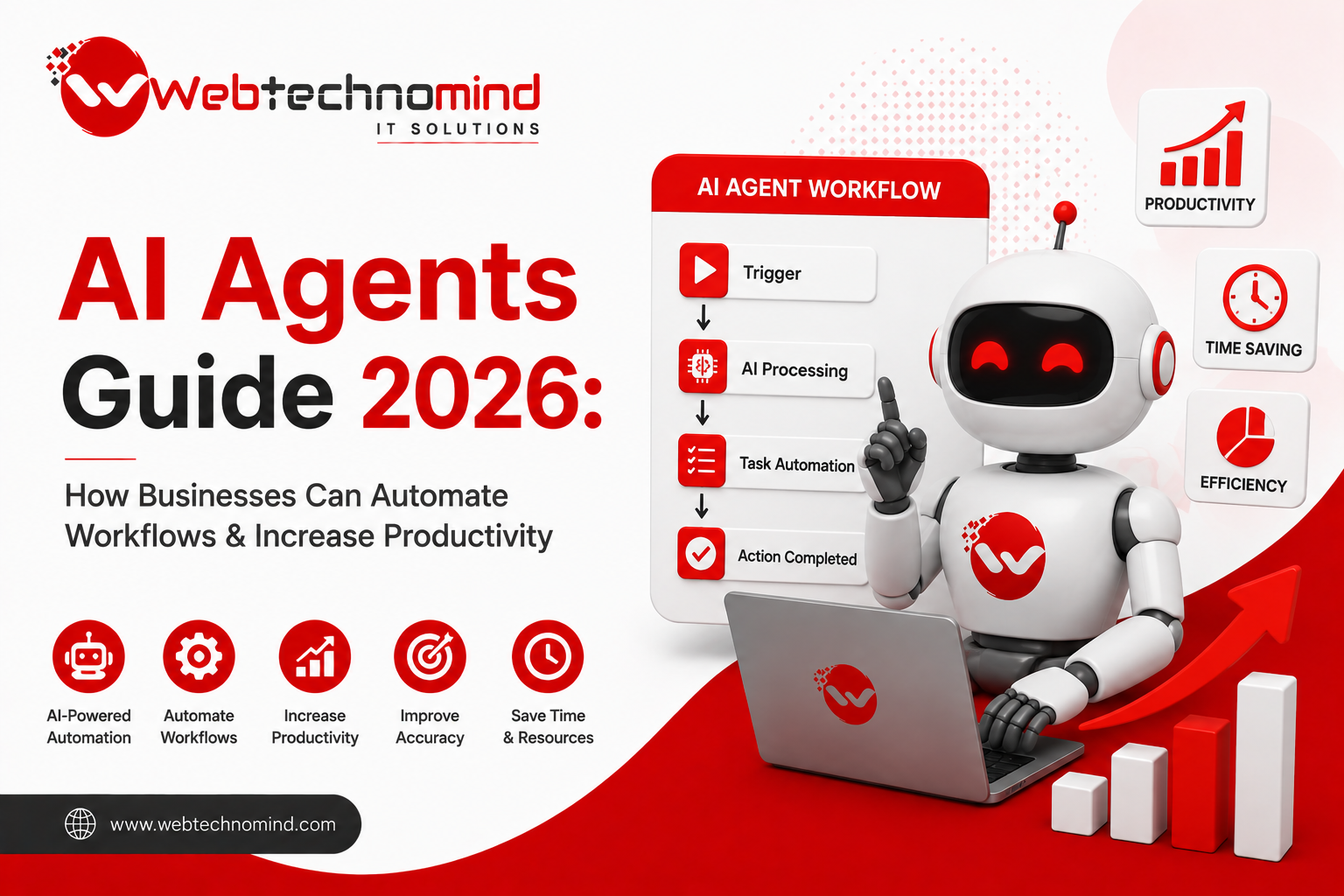
AI Agents Guide 2026: How Businesses Can Automate Workflows & Increase Productivity
- By admin
- Sep 02, 2026








Artificial intelligence is moving beyond simple chatbots and content-generation tools. In 2026, businesses are increasingly using AI agents to perform tasks, make decisions, connect software systems, and automate complete workflows with minimal human intervention.
Unlike traditional automation, which usually follows fixed rules, AI agents can understand goals, analyze information, choose actions, and adapt to changing situations. This makes them valuable for companies looking to reduce repetitive work, improve productivity, and scale operations without continuously increasing their workforce.
From customer support and sales to finance, marketing, HR, and software development, AI agents are becoming an important part of modern business technology.
AI agents are software systems powered by artificial intelligence that can understand instructions, reason about tasks, use connected tools, and take actions to achieve specific objectives.
A traditional automation might follow a simple process:
Receive form → Add information to CRM → Send email
An AI agent can handle a more complex workflow:
Receive inquiry → Understand customer requirements → Check CRM history → Identify the appropriate service → Prepare a personalized response → Schedule a follow-up → Update the CRM → Notify the sales team
The key difference is that AI agents can make context-aware decisions instead of simply executing predetermined instructions.
Most AI agents combine several technologies to complete tasks effectively.
AI agents often use large language models (LLMs) to understand natural language, analyze information, generate responses, and reason through problems.
Agents can connect with business applications such as CRMs, email platforms, accounting systems, project-management software, databases, and communication tools.
This allows an AI agent to move from simply providing information to actually performing tasks.
An effective agent can use relevant information from previous interactions, company documentation, customer records, and databases to make better decisions.
AI agents can coordinate multiple steps in a workflow. Depending on the task, they may decide which tool to use, what action should happen next, and when human approval is required.
The biggest reason businesses are exploring AI agent automation is productivity.
Employees spend significant amounts of time on repetitive activities such as data entry, email management, reporting, research, scheduling, document processing, and customer follow-ups.
AI agents can take over many of these tasks, allowing employees to focus on activities that require creativity, strategy, relationships, and human judgment.
Businesses can benefit from AI agents in several ways:
AI agents can handle common customer questions, identify customer intent, search knowledge bases, provide answers, and escalate complex issues to human representatives.
For example, an e-commerce AI agent could answer questions about orders, shipping, returns, product availability, and delivery status.
Instead of replacing the support team completely, the agent can handle repetitive requests while human employees focus on difficult or high-value cases.
AI agents can help sales teams automatically process incoming leads.
An agent can:
This can significantly reduce the amount of manual administrative work performed by sales teams.
Marketing teams can use AI agents to support research, content planning, campaign analysis, audience segmentation, and reporting.
For example, an AI marketing agent could analyze campaign performance, identify underperforming channels, summarize customer behavior, and prepare recommendations for the marketing team.
AI agents can also support SEO workflows by researching topics, analyzing search intent, organizing content opportunities, and monitoring website performance.
AI agents can assist with invoice processing, expense categorization, payment reminders, financial reporting, and document verification.
For example, an agent can receive an invoice, extract relevant information, compare it against purchase records, identify discrepancies, and send it for approval.
Human approval can remain part of the workflow for sensitive financial decisions.
HR departments can automate many repetitive employee-related processes.
AI agents can help answer employee questions, organize onboarding tasks, prepare documentation, schedule interviews, collect information, and route HR requests to the appropriate department.
This gives HR teams more time to focus on employee engagement, workforce planning, and organizational development.
AI agents can also become digital assistants for IT teams.
They can monitor alerts, analyze system information, create support tickets, provide troubleshooting instructions, summarize incidents, and escalate serious problems.
For organizations with large technology environments, AI-powered operational workflows can help teams respond to issues more quickly.
Traditional automation is highly effective when processes are predictable and rule-based.
For example:
If a customer submits a form → send confirmation email.
AI agents are more useful when workflows involve unstructured information or changing circumstances.
For example:
Analyze the customer’s request → understand the problem → review previous interactions → determine the appropriate solution → respond or escalate.
This makes AI agents particularly useful for processes where human employees previously had to interpret information before taking action.
However, traditional automation is not disappearing. In many organizations, the best solution is a combination of AI agents and conventional automation.
The goal of AI agents should not simply be to eliminate tasks or reduce headcount. Their bigger opportunity is to augment employees.
Imagine a salesperson receiving 50 leads every day. Instead of manually reviewing every lead, an AI agent could analyze them, identify the highest-potential prospects, research their companies, prepare summaries, and recommend next steps.
The salesperson then spends time talking to qualified prospects instead of performing administrative work.
This creates a more productive human-AI workflow.
Businesses should avoid trying to automate everything at once.
A practical approach is to start with one repetitive, measurable workflow.
Look for tasks that are frequent, time-consuming, and relatively predictable.
Determine what success means. It could be faster response times, lower processing costs, higher lead conversion, or fewer manual hours.
Depending on the workflow, you may need a simple AI assistant, a tool-using agent, or a multi-agent system where different agents handle specialized responsibilities.
Integrate the agent with the applications and databases it needs to complete its tasks.
Sensitive workflows should include human approval, particularly for financial transactions, legal decisions, security-related actions, and important customer decisions.
Track performance continuously. Monitor accuracy, completion rates, response times, cost savings, and employee feedback.
AI agents offer significant potential, but they also introduce challenges.
Businesses need to consider data privacy, security, access permissions, inaccurate AI responses, system failures, integration complexity, and governance.
An AI agent should only have access to the information and systems it genuinely needs. Businesses should also maintain clear approval processes for high-risk actions.
Testing is equally important. Agents should be evaluated against real-world scenarios before being given permission to perform critical tasks independently.
The next stage of business automation will likely involve AI agents working alongside employees and existing software.
Instead of opening multiple applications, searching through information, copying data, and manually completing repetitive tasks, employees will increasingly describe the desired outcome and allow AI systems to coordinate the underlying workflow.
This shift could transform how companies operate.
The competitive advantage will not necessarily come from simply having an AI agent. It will come from designing better AI-powered workflows, integrating them with business systems, and using human expertise where it creates the most value.
AI agents in 2026 are becoming an important business technology because they can move automation from simple rule-based tasks to intelligent, goal-oriented workflows.
Businesses can use AI agents to automate customer service, sales operations, marketing, finance, HR, IT support, research, and many other processes.
The most successful organizations will take a practical approach: identify valuable workflows, start small, integrate AI with existing systems, maintain human oversight, and continuously measure results.
AI agents are not simply another productivity tool. They represent a shift toward businesses where intelligent software can actively participate in everyday operations—and companies that learn how to use that capability effectively can gain a significant productivity advantage.
Read More
Artificial Intelligence (AI) is transforming how businesses operate, communicate with customers, analyse data, and deliver services. From intelligent...
Artificial intelligence is rapidly changing how businesses handle content, customer support, software development, research, and everyday operations. Among...
Artificial intelligence is changing how businesses handle repetitive tasks, customer communication, data processing, content creation, and decision-making. But...
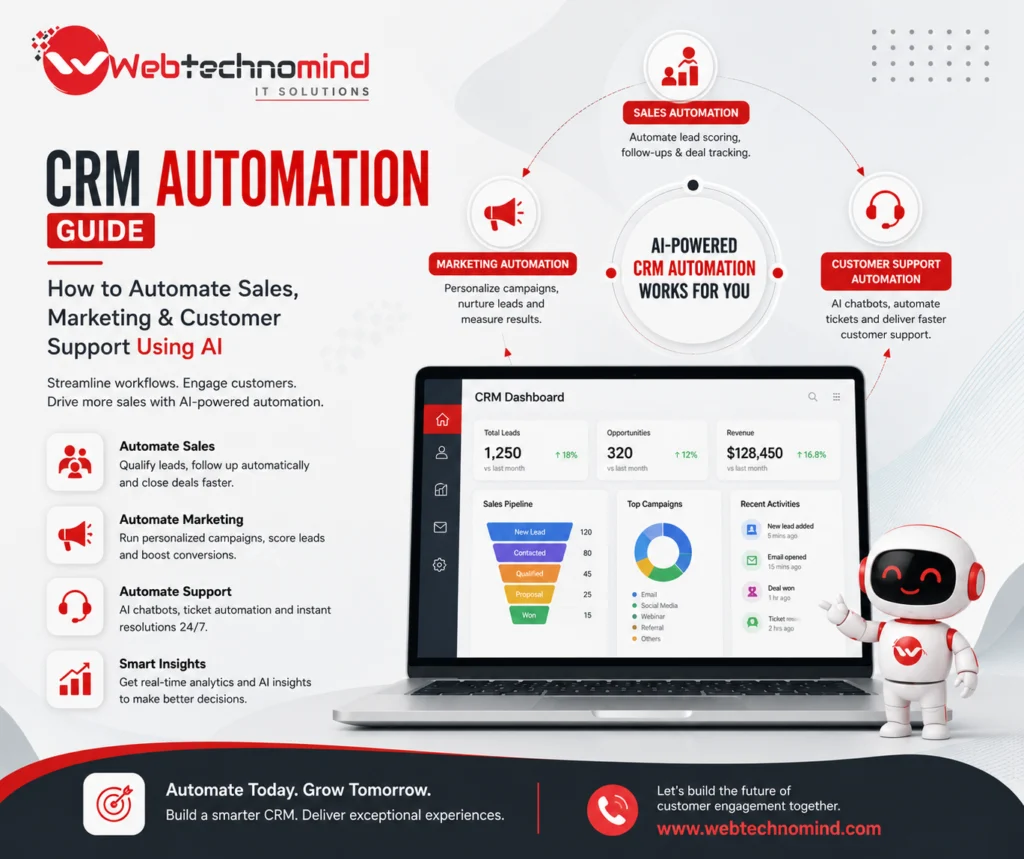
Introduction Managing customer relationships manually can quickly become difficult as a business grows. Sales teams need to follow...