Google AI Overviews Explained: How to Rank in AI-Generated Search Results
- By admin
- Aug 18, 2026

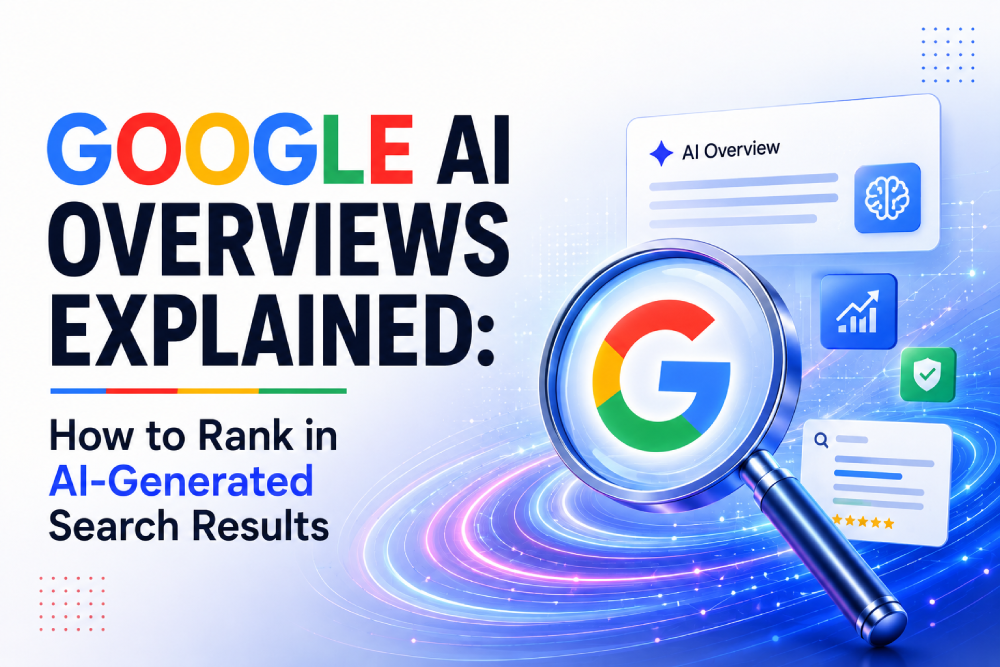







Google Search is changing rapidly. Instead of showing only a traditional list of blue links, Google increasingly uses artificial intelligence to summarize information and help users explore complex questions.
One of the most important developments is Google AI Overviews, which provides AI-generated summaries at the top of relevant search results along with links to supporting webpages. For businesses investing in SEO, this creates a new opportunity to reach potential customers through AI-generated search experiences.
The question is no longer only “How do I rank on Google?” It is also “How can I make my content more visible in AI-generated search results?”
Let’s explore what Google AI Overviews are and how businesses can optimize their websites for the changing search landscape.
Google AI Overviews are AI-generated summaries that can appear at the top of Google Search for certain queries. They are designed to give users a quick understanding of a topic while providing links to relevant websites for additional information.
AI Overviews are particularly useful for complex or multi-part searches where users would traditionally need to visit several websites to find an answer.
For businesses, this means that search visibility is becoming more than simply achieving a top organic ranking. Your content may also become part of an AI-generated answer when it provides relevant, trustworthy, and useful information.
AI search is changing the way customers discover information, products, and services.
Instead of searching for short keywords such as:
“AI app development”
a potential customer may search:
“How much does AI app development cost for a small business?”
Or:
“What features should an AI-powered mobile application have?”
Google can understand these longer, conversational queries and provide a summarized answer.
This creates a major opportunity for businesses that create content answering specific customer questions.
There is no guaranteed shortcut or secret formula for appearing in Google AI Overviews.
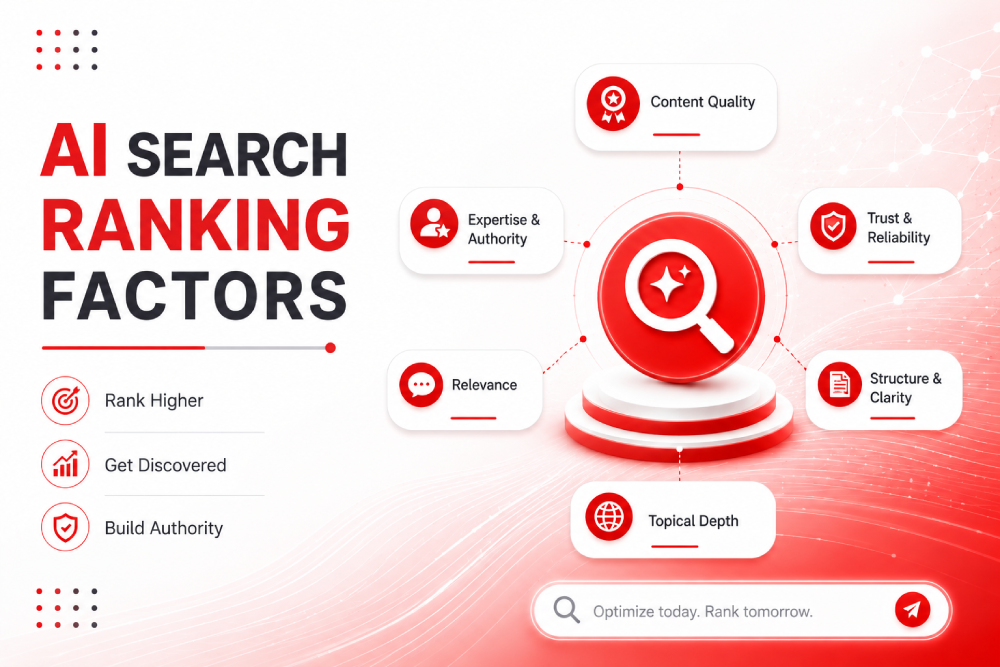
The fundamentals of good SEO still matter. Google needs to be able to discover, understand, and evaluate your website and its content.
Important areas to focus on include:
The goal should be to create content that genuinely helps users rather than content designed only to manipulate search rankings.
The foundation of AI search optimization is high-quality, people-first content.
Avoid publishing generic articles that simply repeat information already available on hundreds of websites.
Instead, add genuine value through:
For example, instead of writing another generic article about “digital marketing,” a digital agency could publish a detailed guide explaining how a specific type of business can generate qualified leads using SEO, Google Ads, and conversion optimization.
Useful and original information gives your content a stronger chance of being discovered and referenced.
AI-powered search encourages users to ask complete questions.
Traditional keyword:
“CRM software”
Conversational search:
“What CRM features does a growing small business actually need?”
Create content that addresses these longer and more specific queries.
You can find potential questions by analyzing:
The more closely your content matches real user questions, the more useful it becomes.
Publishing one article about a subject is rarely enough to establish strong authority.
Instead, create a collection of related content around your core expertise.
For example, a technology company could build an AI development content cluster covering:
Connect these articles with relevant internal links.
This creates a structured content ecosystem that helps users explore a topic while strengthening your website’s overall topical relevance.
AI systems and human readers both benefit from well-structured content.
Use:
Answer the main question directly before providing additional details.
For example:
Start with a concise definition and then explain its benefits, technologies, development process, costs, and use cases.
This makes the content easier to understand and navigate.
E-E-A-T stands for Experience, Expertise, Authoritativeness, and Trustworthiness.
These principles are especially important when creating content that businesses and customers rely on for decisions.
Demonstrate expertise through:
For a technology company, showing real experience in AI, web development, mobile applications, software development, and digital transformation can make content more credible.
Even excellent content needs to be accessible to search engines.
Make sure your website:
Technical SEO creates the foundation that allows search engines to discover and understand your content.
Search is becoming increasingly visual and multimodal.
Useful images, videos, infographics, screenshots, charts, and original illustrations can make content more valuable.
For example, an AI development company could include:
However, media should support the content rather than simply fill space.
Artificial intelligence can be extremely useful for research, brainstorming, outlining, and editing. However, publishing large quantities of low-quality AI-generated content is not a sustainable SEO strategy.
AI-generated content should be reviewed and improved by humans.
A stronger approach is:
AI-assisted research + human expertise + original insights + editorial review.
Your content should provide something useful that readers cannot get simply by asking an AI tool the same question.
AI search visibility is not limited to your website.
Your brand should have a consistent presence across the wider digital ecosystem.
Focus on:
The goal is to build genuine brand recognition and authority.
Avoid creating artificial mentions or low-quality backlinks simply to increase numbers. Relevance and credibility are more valuable than volume.
Don’t focus only on generic keywords.
Build visibility around your brand name and associated services.
For example, users might search:
Your About page, service pages, case studies, portfolio, reviews, and social profiles should communicate a consistent brand identity.
The clearer your brand information is across the web, the easier it becomes for users and search systems to understand your business.
AI search is evolving quickly, so businesses should regularly evaluate how their content and brand appear in AI-generated results.
Monitor:
Don’t judge SEO success only by keyword rankings.
The real objective is to generate qualified visibility, website traffic, leads, and revenue.
Before optimizing your website for AI-generated search results, make sure you:
Traditional SEO and AI search optimization should work together.
Traditional SEO focuses on:
AI search optimization focuses on:
The strongest strategy combines both approaches.
Google AI Overviews are changing how people discover information online, but they do not make traditional SEO irrelevant. Instead, they make high-quality SEO more important.
Businesses should focus on creating content that is useful, original, trustworthy, easy to understand, and supported by genuine expertise.
There is no magic trick for ranking in AI-generated search results. The best approach is to build a website that Google can crawl, users can trust, and AI systems can understand.
At WebTechnoMind, we help businesses strengthen their digital presence through SEO, AI solutions, web development, mobile app development, and digital marketing strategies designed for the evolving search landscape.
If your business wants to remain visible as search becomes more AI-driven, now is the right time to build a strong foundation of SEO, content, authority, and brand trust.
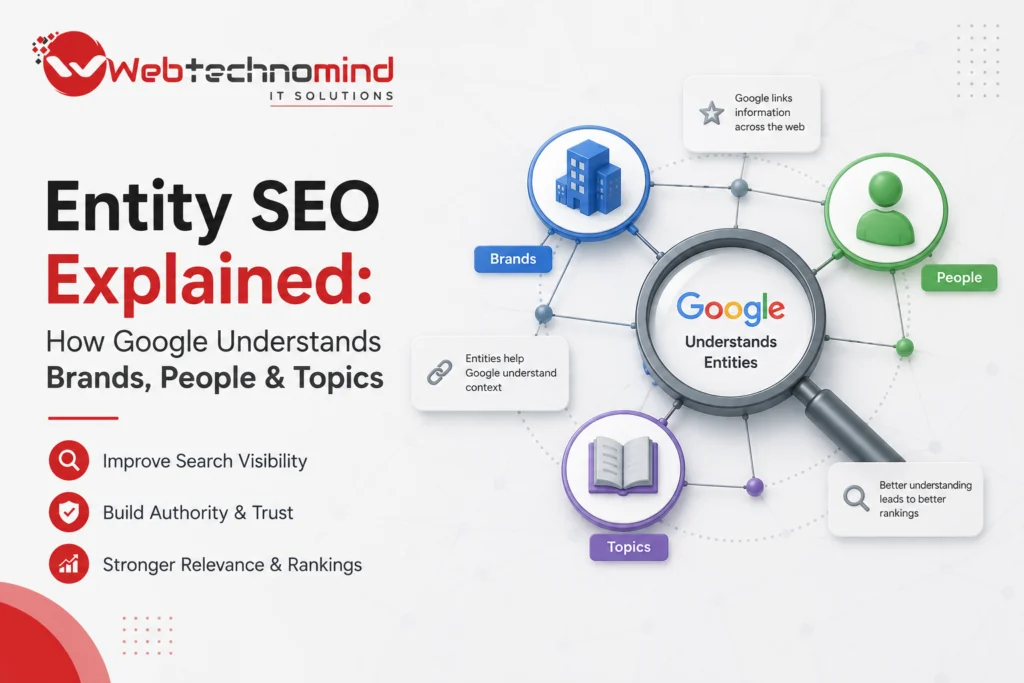
Search engines have changed significantly over the years. Earlier, Google primarily matched keywords on a webpage with the...
The way people search for information is changing rapidly. Traditional search engines are no longer the only way...
Search is evolving. People are no longer relying only on traditional search engines to find information, products, and...
Search is evolving from traditional keyword-based results to AI-powered experiences. Platforms such as Google AI Overviews, Google AI...