AI Infrastructure Investment Continues Accelerating as Companies Race to Meet Growing Demand
- By admin
- Aug 25, 2026

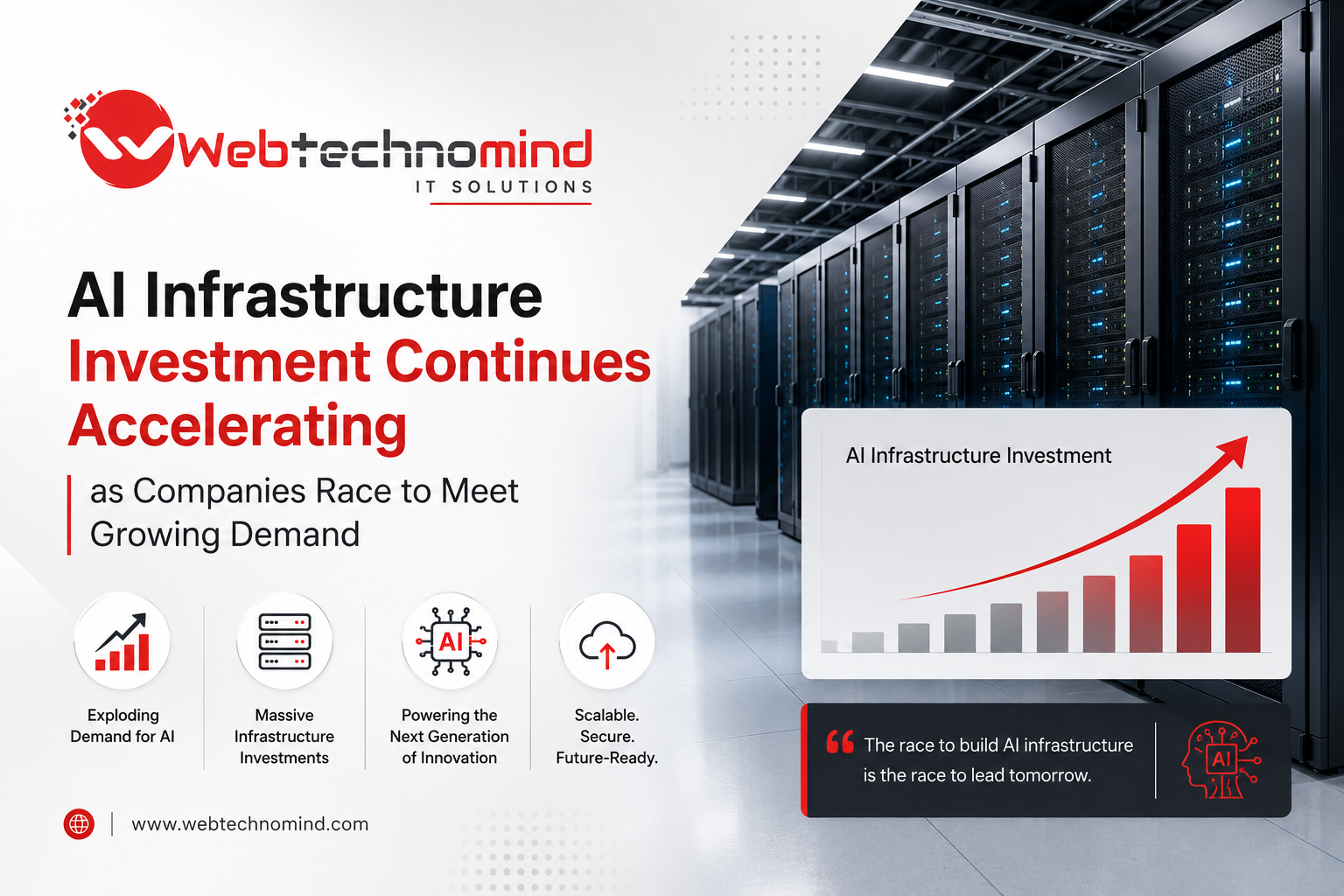







Investment in artificial intelligence infrastructure continues to accelerate in 2026 as technology companies, cloud providers and investors increase spending on data centers, AI chips, servers, networking equipment and power infrastructure.
The latest spending trends indicate that the AI boom is moving beyond software development. Companies are now competing to secure the physical computing capacity required to train and run increasingly sophisticated AI models.
According to Gartner, worldwide AI spending is expected to reach $2.59 trillion in 2026, representing a 47% increase from the previous year. AI infrastructure—including AI-optimized servers, networking, semiconductors and infrastructure services—is expected to account for more than 45% of total AI spending.
Large cloud and technology companies are at the center of this infrastructure expansion. Microsoft, Google, Amazon, Meta and Oracle are collectively increasing capital expenditure to build additional computing capacity.
TrendForce estimates that combined 2026 capital expenditure from nine major cloud service providers—including Google, Amazon, Microsoft, Meta and Oracle—could exceed $886.7 billion, with North American hyperscalers representing the majority of the spending. The research firm also raised its forecast for AI server shipments in 2026 to nearly 31% year-over-year growth.
This spending is being directed toward advanced GPUs, AI servers, custom AI accelerators, high-speed networking and large-scale data center facilities.
The investment is necessary because generative AI applications require significantly more computing resources than many traditional software workloads. As businesses deploy AI agents, multimodal models and enterprise AI applications, demand for computing capacity is expected to continue rising.
Data centers have become one of the most important components of the AI infrastructure race.
AI workloads require specialized facilities capable of handling high-density computing equipment, advanced cooling systems and substantial electricity consumption. As a result, investment is increasingly extending beyond servers and chips into power generation, cooling, land acquisition and data center development.
Nvidia recently invested in data center developer Cloverleaf Infrastructure to help accelerate the construction of AI-focused data center capacity across the United States.
The development highlights an important change in the technology industry: AI companies are increasingly becoming involved in the infrastructure that supports their computing requirements.
The rapid expansion of AI data centers is also creating significant demand for electricity.
AI servers consume considerably more power than conventional computing systems, making access to reliable electricity a major factor in determining where new data centers can be built.
Energy and power infrastructure companies are consequently attracting increasing interest from investors. Aggreko, for example, recently filed for a U.S. IPO as demand for its power solutions grows alongside the data center boom. The company’s data center revenue nearly doubled for the year ended January 2026.
This trend suggests that the AI infrastructure market is expanding into adjacent industries such as electricity generation, grid equipment, cooling, batteries and energy management.
India is also becoming a major destination for AI infrastructure investment.
Amazon announced an additional $13 billion investment to expand its AI and cloud infrastructure in India through 2030, taking its announced investment in the country to $48 billion between 2026 and 2030. The investment will support additional AWS data center capacity in locations including Mumbai and Hyderabad.
Meta has also partnered with Reliance Industries on an AI-enabled data center in Jamnagar, Gujarat. The facility is intended to provide infrastructure for Meta’s products and AI capabilities in India. Meta is separately supporting nearly 1 GW of renewable energy through partnerships with clean-energy providers.
These developments demonstrate India’s growing importance in the global AI infrastructure ecosystem.
AI infrastructure investment is not limited to data centers. Semiconductor technology is another major area of competition.
Cloud providers are increasingly developing their own AI accelerators alongside purchasing GPUs from companies such as Nvidia and AMD. Custom chips can potentially improve performance, reduce costs and optimize infrastructure for specific AI workloads.
Google’s recent agreement with Marvell Technology to expand its custom AI chip capabilities is another example of the industry’s growing focus on specialized AI hardware.
At the same time, AI infrastructure companies are placing large orders for next-generation processors. In India, AM Intelligence announced an investment exceeding $8 billion in global AI computing infrastructure and an initial order for 9,000 Nvidia Vera Rubin GPUs for a planned AI facility in Hyderabad.
The acceleration of AI infrastructure investment signals that the next phase of artificial intelligence will depend heavily on physical infrastructure.
Companies that can secure GPUs, electricity, data center capacity and high-speed networking may gain an advantage as AI adoption expands. However, the enormous spending also creates financial pressure. Reuters reported that capital expenditure by major U.S. hyperscalers could rise faster than their free cash flow, increasing scrutiny over whether future AI revenues will justify today’s infrastructure investments.
For businesses, developers and investors, this means AI infrastructure is becoming a strategic technology category rather than simply a back-end requirement.
AI infrastructure investment is expected to remain a major technology trend as companies continue expanding AI services and enterprise adoption.
The market is likely to see continued investment across data centers, GPUs, AI servers, cloud platforms, networking, cooling and energy infrastructure. At the same time, companies will increasingly look for ways to improve computing efficiency and reduce the cost of operating large AI systems.
The AI race is therefore evolving into an infrastructure race. While software and AI models remain highly visible, the ability to build and power the computing infrastructure behind them could become one of the most important competitive advantages in the technology industry.
For businesses watching the AI market, the message is clear: AI infrastructure investment is no longer a future opportunity—it is already becoming one of the largest drivers of global technology spending.

Webtechnomind IT Solutions Pvt. Ltd. is proud to announce a remarkable achievement that marks another important milestone in...
You’re here because you need to build a hybrid app and don’t want to waste time (or money)...