Complete On-Page SEO Checklist for 2026
- By admin
- Aug 17, 2026
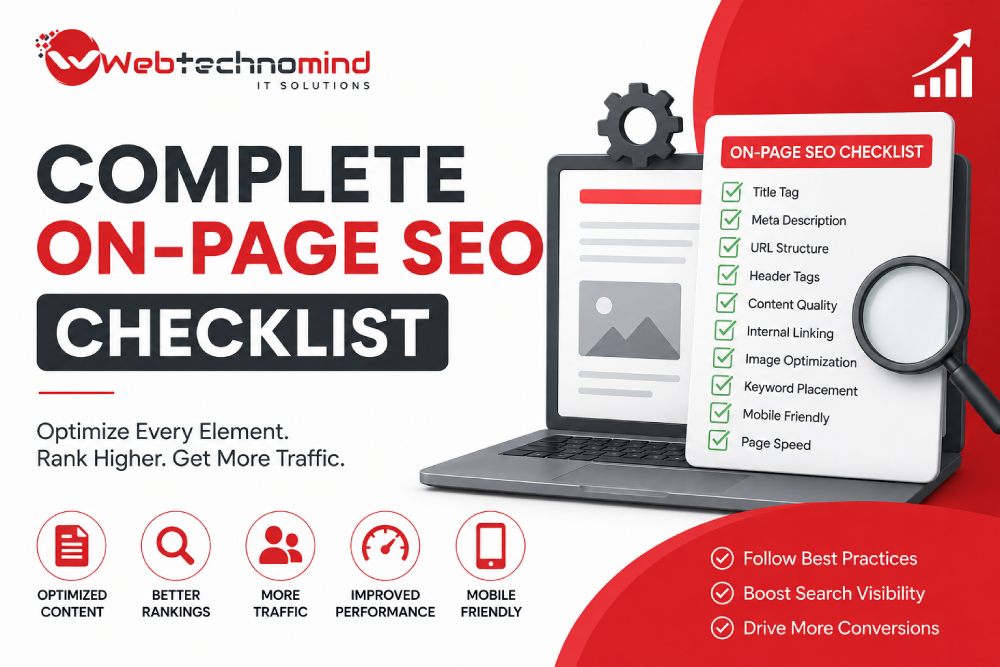







Search engine optimization continues to evolve, but one thing remains consistent: your website needs a strong on-page SEO foundation.
In 2026, simply adding keywords to a webpage is not enough. Search engines increasingly focus on relevance, helpful content, user experience, website structure, page performance and search intent.
Whether you manage a business website, blog, eCommerce store or service website, this complete on-page SEO checklist for 2026 can help you optimize your pages for better search visibility and qualified organic traffic.
On-page SEO refers to optimizing the elements of individual webpages to help search engines understand the content and help users find the information they need.
Important on-page SEO elements include:
A successful SEO strategy combines these elements rather than relying on a single ranking factor.
Before creating or optimizing content, identify why someone is searching for the topic.
Search intent generally falls into categories such as:
Your content should directly satisfy the intent behind the target keyword.
For example, someone searching for “best SEO agency for small businesses” may be looking for comparisons and recommendations, while someone searching “what is on-page SEO” primarily wants an explanation.
Your SEO title is one of the first things users see in search results.
For example:
Good:
Complete On-Page SEO Checklist for 2026
Weak:
SEO | SEO Checklist | On-Page SEO | SEO Tips | SEO 2026
Your title should be written primarily for users, not just search engines.
A meta description summarizes your webpage in search results and can influence whether users choose to click.
A good meta description should:
Avoid stuffing keywords into the description.
Your H1 should clearly communicate the main topic of the page.
For this article:
H1: Complete On-Page SEO Checklist for 2026
Use H2 and H3 headings to organize supporting information.
A logical heading structure makes long-form content easier for both users and search engines to understand.
Create short, readable and descriptive URLs.
Recommended:
/blog/complete-on-page-seo-checklist-2026/
Avoid:
/blog/article?id=23874&category=seo
Keep unnecessary numbers, parameters and complicated URL structures out of important SEO pages whenever possible.
Your primary keyword should appear naturally in important areas of the page.
Consider using it in:
Also use related terms and topical variations.
The goal is topical relevance, not keyword repetition.
High-quality content is at the heart of modern SEO.
Before publishing, ask:
Does this article genuinely answer the user’s question?
Your content should:
Do not increase an article’s word count simply to make it longer. Content quality and usefulness are more important than an arbitrary word count.
Internal links connect pages within your website and help users discover additional relevant information.
For example, an article about SEO can link naturally to your SEO services page.
You can also link relevant articles to your digital marketing services and website development services.
A well-planned internal linking structure can also help search engines discover and understand relationships between pages.
Images can improve content quality and engagement, but unoptimized images can negatively affect page performance.
Follow these practices:
For example:
Poor filename:
IMG_8492.jpg
Better filename:
on-page-seo-checklist-2026.jpg
Alt text should describe the image accurately rather than being used as a place to insert keywords.
Website performance remains an important part of providing a good user experience.
Monitor Google’s Core Web Vitals:
Ideally, pages should load quickly, respond smoothly and avoid unexpected layout movement.
If your website requires technical improvements, WebTechnoMind’s website development services can help improve website performance, usability and scalability.
Your website should provide a consistent experience across desktop, tablet and mobile devices.
Check:
A page that works perfectly on desktop but is difficult to use on mobile can create a poor user experience.
Structured data helps search engines understand specific types of content.
Depending on your page, relevant schema types may include:
Only implement structured data that accurately represents the content visible on the page and follows search engine guidelines.
SEO should not only generate traffic. It should help generate business results.
Every important commercial page should have a clear call to action.
Depending on your business, this could be:
A successful SEO page attracts the right audience and guides visitors toward the next step.
SEO is not a one-time activity.
Regularly review your existing pages for:
Updating valuable existing content can be an important part of maintaining organic visibility.
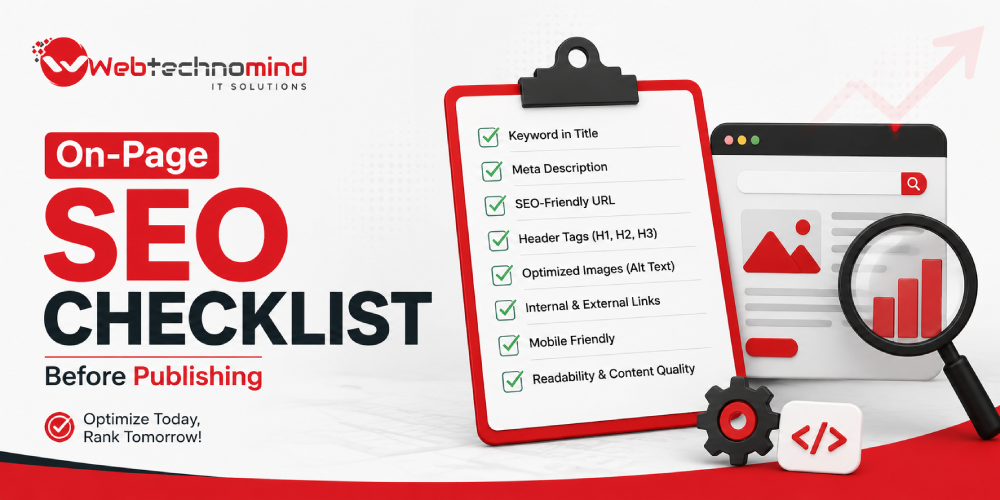
Use this quick checklist before publishing any webpage:
A strong on-page SEO strategy in 2026 requires much more than placing keywords throughout an article. Search intent, useful content, website structure, internal linking, image optimization, mobile usability, page performance and conversion optimization all contribute to a stronger website.
Use this complete on-page SEO checklist whenever you publish or update a webpage. Consistently optimizing these elements can help create a website that is easier for search engines to understand and more valuable for your visitors.
If you want to improve your website’s organic visibility, WebTechnoMind’s SEO services can help with keyword research, on-page SEO, technical optimization, content strategy, local SEO and long-term organic growth.
In today’s competitive digital marketplace, having a website is only the first step towards building a successful online...
In today’s digital-first marketplace, having a website is not enough. Your customers need to find your business when...
Search is changing. People are no longer relying only on traditional Google results to discover businesses, products and...
Search is changing. People no longer rely only on traditional Google results to discover businesses, products, services, and...