


June 9, 2026
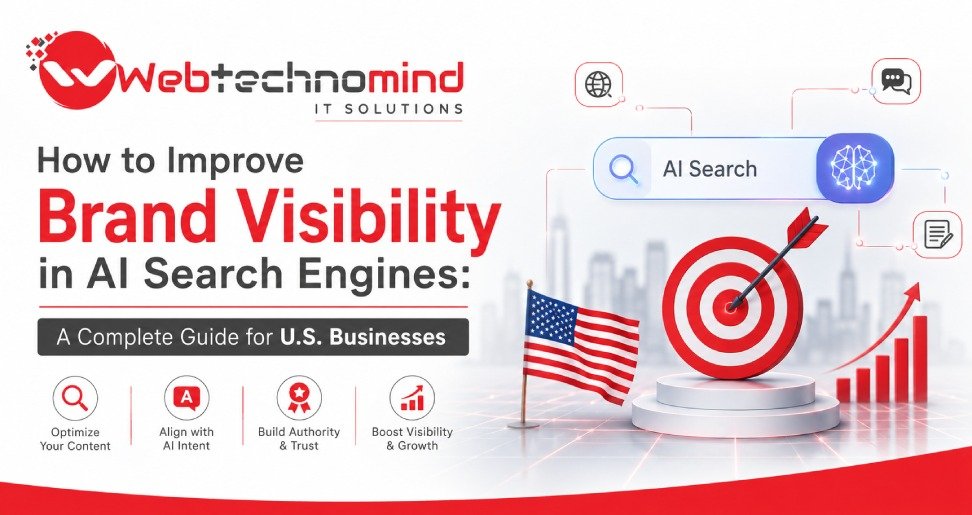
The way people search online is changing rapidly. Instead of relying solely on traditional search engines like Google, users are increasingly turning to AI-powered platforms such as ChatGPT, Google AI Overviews, Perplexity AI, and Microsoft Copilot to get direct answers.
For businesses across the United States, this shift creates both challenges and opportunities. Ranking on Google is no longer enough. Your brand must also be visible, trusted, and cited by AI search engines.
If you're wondering how to improve brand visibility in AI search engines, this guide will walk you through the strategies that help brands become discoverable in the era of AI-powered search.
AI search platforms don't simply display a list of websites. Instead, they generate answers by analyzing information from multiple sources and citing the most authoritative content. This means brands that establish credibility, expertise, and strong digital signals have a greater chance of being recommended in AI-generated responses.
For U.S. businesses, AI visibility can result in:
As AI search adoption continues to grow, companies that adapt early will gain a competitive advantage.
Traditional SEO focuses on ranking webpages for keywords.
AI Search Optimization, often called AEO (Answer Engine Optimization) and GEO (Generative Engine Optimization), focuses on helping AI systems understand, trust, and reference your content when answering user questions.
Businesses that combine both SEO and AI optimization are achieving the best results in modern search environments.
AI search engines prefer sources that demonstrate expertise in a particular subject.
Rather than publishing random content, focus on creating comprehensive content clusters around your industry.
For example, if you offer digital marketing services, create content around:
When AI systems consistently see your website covering a topic in depth, they are more likely to view your brand as an authority.
You can naturally link to service-related pages such as:
AI platforms are designed to answer questions.
Instead of targeting only keywords, structure your content around user intent and real-world questions.
Examples:
Microsoft and other industry experts recommend creating clear Q&A content because it helps AI systems understand and extract answers more effectively.
AI systems rely heavily on entities.
An entity is a recognizable brand, person, organization, or concept.
To improve visibility:
The stronger your entity recognition becomes, the easier it is for AI search engines to identify and recommend your business.
Schema markup helps search engines and AI systems understand your website.
Important schema types include:
Structured data acts as a machine-readable guide that helps AI platforms interpret your content accurately. Industry experts consistently identify schema implementation as a critical AI visibility factor.
AI systems prioritize trustworthy information.
To increase credibility:
Quality content remains one of the strongest signals for both traditional and AI-powered search visibility.
Research shows that AI search engines often rely heavily on authoritative third-party sources when generating responses.
To improve your visibility:
The more authoritative websites mention your brand, the more confidence AI systems gain in recommending you.
AI optimization starts with a technically sound website.
Key areas include:
Without strong technical SEO, AI crawlers may struggle to access and understand your content.
Generic content is becoming less effective.
AI platforms increasingly value unique information, expert analysis, and firsthand experience.
Examples include:
Original content helps your brand become a source rather than just another publisher repeating existing information.
As AI-powered search continues to reshape online discovery, businesses need more than traditional SEO.
Web Technomind helps brands build visibility across modern search ecosystems through:
By combining SEO, AEO, GEO, content optimization, and technical improvements, Web Technomind helps businesses position themselves as trusted sources for both search engines and AI platforms.
For future interlinking opportunities, consider using anchor texts such as:
These anchors align naturally with the topic and can help strengthen topical authority across your website.
AI search is not replacing SEO—it is expanding it.
Businesses that focus on:
will be better positioned to earn citations and recommendations from AI-powered search engines. Experts from Google, Microsoft, and Perplexity continue to emphasize that quality content and brand trust remain the foundation of visibility in AI search.
The brands that invest in AI search optimization today will be the ones consumers discover tomorrow.
Ans :- To make your brand appear in AI searches, focus on creating authoritative content, implementing structured data, improving technical SEO, building strong brand mentions across the web, and optimizing content for user questions. AI platforms are more likely to cite brands they trust and understand.
2. How can brand visibility be improved?
Ans :- Brand visibility can be improved through consistent content marketing, SEO, PR campaigns, social proof, authoritative backlinks, thought leadership, and AI search optimization strategies. Building trust and topical authority increases your chances of being discovered online.
3. How to boost AI visibility?
Ans :- Boosting AI visibility requires a combination of Answer Engine Optimization (AEO), Generative Engine Optimization (GEO), structured content, FAQ implementation, schema markup, and authoritative brand mentions. Businesses that provide clear, accurate, and trustworthy information are more likely to be featured in AI-generated responses


